April 24, 2013

A’lor Loses Cable Motif Jewelry Copyright And Trade Dress Infringement Lawsuit

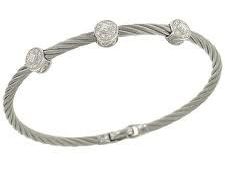
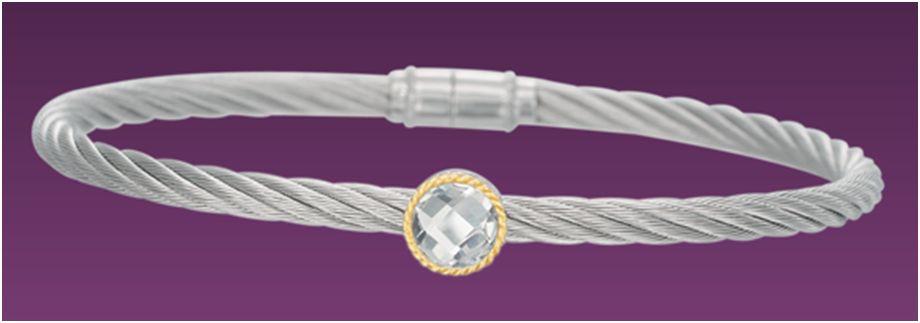
Jewelry-copyright-attorney-trade-dress-sued-court-los-angeles-alor.jpgLos Angeles, CA - A’lor International sued numerous jewelry designers, producers and retailers for copyright and trade dress infringement over sales various nautical twisted cable motif jewelry. A’lor filed a summary adjudication motion asking the Court to deem Defendants liable for copyright and trade dress infringement. Defendant Lau filed a motion for partial summary judgment that it did not infringe A’lor’s copyrights and Defendant Miami Lakes filed a motion regarding the trade dress infringement claims, which motions were joined by several defendants.

To succeed on its copyright infringement claims, Plaintiff must show that (1) Plaintiff owns valid copyrights in the Subject Designs; and (2) Defendants infringed on Plaintiff’s copyright. Lamps Plus, Inc. v. Seattle Lighting Fixture Co., 345 F.3d 1140 (9th Cir. 2003). The Court held that A’lor’s copyright registration certificates constituted prima facie evidence of a valid copyright, which presumption of validity defendants were unable to rebut. 17 U.S.C. § 410(c). To rebut the presumption, Defendants argued that the copyrights were invalid because they lack originality. Satava v. Lowry, 323 F.3d 805, 811 (9th Cir. 2003). The Court, however, found that Defendants submitted evidence of pre-existing nautical twisted cable motif jewelry sold by third parties and to provide copyright protection to Plaintiff’s would improperly give Plaintiff a monopoly on nautical rope band jewelry. Nevertheless, the Court found that Plaintiff was entitled to a “thin” copyright in the style of the clasp or other ornaments and panther heads. But once the court subtracted the unoriginal elements and considered only Plaintiff’s original contributions, no copyright infringement could be found because virtually identical copying didn't exist, the proper infringement test for a “thin” copyright.

Regarding its trade dress infringement claim, A’lor had to show that (1) the trade dress is nonfunctional; (2) the trade dress has acquired secondary meaning, and (3) there is a substantial likelihood of confusion between the Accused Designs and the Subject Designs. See Art Attacks v. MGA Entertainment, Inc., 581 F.3d 1138, 1145 (9th Cir. 2009). “Trade dress” refers to the “total image of a product” and may include features such as size, shape, color, color combinations, texture or graphics. International Jensen, Inc. v. Metrosound U.S.A., Inc., 4 F.3d 819, 822 (9th Cir. 1993). Because the scope of trade dress protection may be broad, courts exercise particular caution when extending protection to product designs, as granting trade protection to an ordinary product design would create a monopoly in the goods themselves. Landscape Forms, Inc. v. Columbia Cascade Co., 113 F.3d 373, 380 (2d Cir. 1997).

A’lor described its trade dress as “interwoven nautical cable threads composed of twisted stainless steel wire forming single- or juxtaposed multi-strand treated cable threading with soft-textured adornments and embellishments spaced through the cable.” The Court found the definition to be amoebic, namely “impermissibly general and overbroad...As such, extending protection to this trade dress would permit Plaintiff to exclude competition from functionally similar products that use stainless steel in nautical cable band jewelry...Therefore, the Court finds that the trade dress, as articulated by Plaintiff, is no more than a concept or idea.”

The case is A’lor International, Ltd. v. Tappers Fine Jewelry, Inc., CV12-02215 RGK (C.D. Cal. 2012).

September 14, 2012

Christian Louboutin’s Red-Sole Shoe Trademark Is Valid, To A Limited Extent: Second Circuit

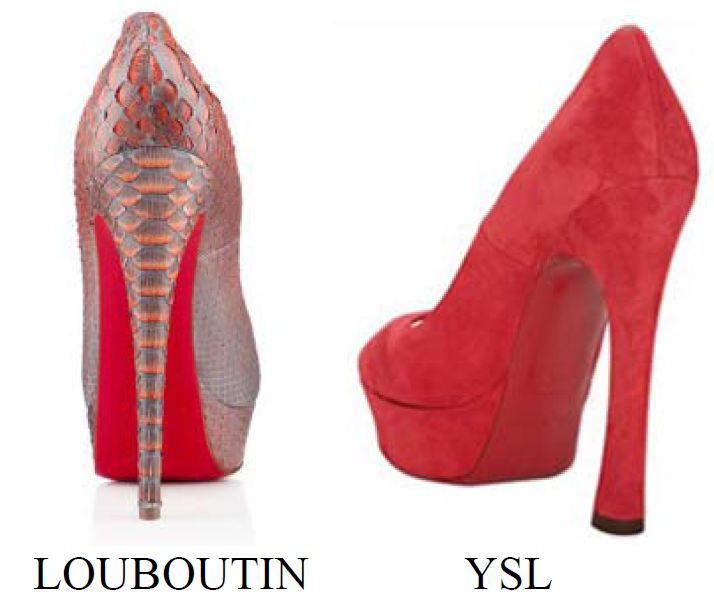
trademark-shoe-christian-louboutin-v-yves-saint-laurent.jpgThe popular Christian Louboutin (CL) shoes’ red sole trademark is readily recognized by the consuming public. But when CL sued Yves Saint Laurent (YSL) for making red soled shoes, the district court disagreed. Finding CL’s red sole trademark unenforceable, the court denied CL’s motion for a preliminary injunction to prevent YSL’s sales of shoes with lacquered red soles.

The Court of Appeals for the Second Circuit concluded that the district court incorrectly held that a single color can never serve as a trademark in the fashion industry. The Court, however, proceeded to then modify CL’s trademark registration for any shoe with a red sole to only apply with red, lacquered outsole with a contrasting upper of the shoe. In other words, the trademark excludes any red shoe with a red sole.

YSL claimed this was not the first time it had designed monochrome footwear with red soles, which it created in the 1970’s prior to CL’s 1992 adoption of the red sole trademark. Thus, YSL filed counterclaims seeking cancellation of CL’s trademark registration because it was ornamental and functional and sought monetary damages for CL’s interference with YSL’s business relations and for unfair competition because many retailers returned YSL’s shoes after receiving CL’s cease and desist letters.

On appeal, Louboutin argues that the District Court erred in (1) holding, based on the doctrine of “aesthetic functionality,” that the Red Sole Mark was not entitled to legal protection; (2) applying the doctrine of aesthetic functionality to hold that a single color on a fashion item could not act as a trademark; (3) failing to give weight to the statutory presumption of validity deriving from the Red Sole Mark’s registration; (4) applying an improper analysis of trademark infringement and dilution; (5) ignoring allegedly undisputed proof of likelihood of confusion and irreparable harm; and (6) announcing a per se rule of functionality in a manner that violated Federal Rule of Civil Procedure 52.

First, the Court, relying on the Supreme Court’s decision in Qualitex Co. v. Jacobson Products Co., 514 U.S. 159, 162 (1995), found that the red sole color is protectable as a trademark because it “acts as a symbol that distinguishes a firm’s goods and identifies their source, without serving any other significant function.” Indeed, Qualitex concluded that “color alone, at least sometimes, can meet the basic legal requirements for use as a trademark. It can act as a symbol that distinguishes a firm’s goods and identifies their source, without serving any other significant function.”

Next, the Court addressed the functionality defense, which has two forms “utilitarian” and “aesthetic”. Utilitarian functionality can be shown if the feature is “essential to the use or purpose of the article” or if it “affects the cost or quality of the article.” Aesthetic functionality is established by demonstrating that providing the markholder the right to use the feature exclusively would put competitors at a significant non-reputation-related disadvantage. The Court held nothing in the fashion world allowed the lower court’s creation of a per se rule that a single color cannot serve as a trademark in that field.

Then, the Court turned to the red sole trademark and found that secondary meaning had been established, which is required to show that a single color has become distinctive, and the red sole was a protectable trademark. “We hold that the lacquered red outsole, as applied to a shoe with an ‘upper’ of a different color, has ‘come to identify and distinguish’ the Louboutin brand, Qualitex, 514 U.S. at 163, and is therefore a distinctive symbol that qualifies for trademark protection.” The Court, however, also found that CL had not established secondary meaning in the red sole as applied to a red shoe and, under 15 U.S.C. § 1119, ordered the USPTO to limit the registration to exclude monochromatic red shoes.

The Court affirmed the denial of the preliminary injunction because YSL’s use of a red sole on a red shoe is not a trademark use and not confusingly similar to CL’s mark. The Court, however, punted on whether the red sole mark as modified was functional and remanded the case for further proceedings on YSL’s counterclaims.

March 21, 2012

Charriol Files Cable Motif Jewelry Copyright and Trade Dress Infringement Lawsuit

UPDATE 4-24-2013: District Court finds non-infringement of trade dress and copyrights on summary judgment.

trade-dress-jewelry-copyright-cable-charriol-yurman-trademark.jpgA’lor International Ltd., dba Charriol USA, is suing sixteen defendants for manufacturing and selling numerous jewelry designs incorporating a nautical cable motif that allegedly infringe Charriol’s copyrights and trade dress. Charriol claims that it has been designing unique jewelry designs for decades, which have either been registered with the U.S. Copyright Office or are pending registration. To see pictures of Charriol’s entire list of asserted designs and allegedly infringing products, click here. Through many years of sales, advertising, and media coverage, Charriol alleges that the cable motif has become its trade dress, meaning that the jewelry’s visual appearance functions as a trademark and consumers associate the appearance with the source of the jewelry. Charriol also asserts a breach of implied contract against four defendants that received samples of the jewelry and agreed to only use the designs if they compensated Charriol.

Charriol’s cable jewelry designs are reminiscent of David Yurman’s twisted cable design. Indeed, Yurman has filed numerous lawsuits for infringement of his copyrights and trade dress in the twisted cable jewelry design. In Yurman Design, Inc. v. PAJ, Inc., the defendant appealed the jury’s verdict awarding Yurman damages for PAJ’s infringement of Yurman’s copyrights and trade dress. The Second Circuit affirmed the finding of copyright infringement despite the use of cable designs by others in the jewelry industry because “the originality in Yurman's four designs inheres in the ways Yurman has recast and arranged those constituent [preexisting] elements. We have carefully reviewed the cable jewelry produced by third parties that PAJ submitted to the jury, and cannot conclude that any of Yurman's four combinations are nonoriginal as a matter of law.” The appellate court, however, reversed Yurman’s trade dress victory because his definition of the trade dress as "the artistic combination of cable [jewelry] with other elements" was overbroad or generic:

Yurman's inability to articulate its trade dress at a lower level of generality is not altogether surprising, given (1) that there are 18 different Yurman pieces in the product line it seeks to protect (eight rings, seven bracelets, and three pairs of earrings), four of which the jury found to be separately copyrightable; and (2) Yurman's concession that the pieces are composed exclusively of elements commonly used in the jewelry industry. A unique combination of elements may make a dress distinctive, but "the fact that a trade dress is composed entirely of commonly used or functional elements might suggest that the dress should be regarded as unprotectible or 'generic,' to avoid tying up a product or marketing idea."

Charriol defines its trade dress as “interwoven nautical cable threads; twisted stainless steel components; 1.0, 1.2, 1.5, 1.6, 5.5, 3.0, and 6.0 millimeter cable composition; electro-polished juxtaposed multi-strand cable threading; treated soft-textured components; poly/physical vapor deposition-treated design elements.” Assuming that it does not suffer Yurman’s overbroad or generic definition of its trade dress, it will be interesting to see how Charriol will argue that its cable jewelry design trade dress has been substantially exclusive in light of Yurman’s similar cable jewelry design.

The case is A’lor International, Ltd. v. Tappers Fine Jewelry, Inc., CV12-02215 RGK (C.D. Cal. 2012).

September 13, 2011

Skechers Sues Steven Madden For Patent and Trade Dress Infringement Over Twinkle Toes Shoes

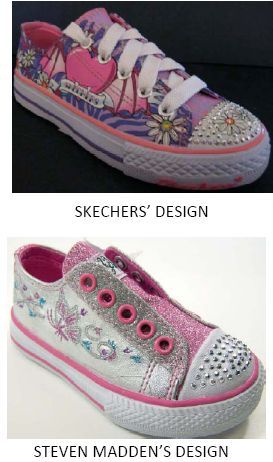
design-patent-shoes-trade-dress-steven-madden-skechers.jpgSkechers is suing Steven Madden for allegedly copying Skechers’ Twinkle Toes shoe designs. The U.S. Patent & Trademark Office granted U.S. Patent No. D571,095 to Skechers covering its Twinkle Toes toe cap design for shoes. In addition to patent protection, Skechers claims that it is the owner of an inherently distinctive trade dress in its Twinkle Toes footwear designs. Skechers defines its trade dress as the combination of the following design elements: “a vulcanized canvass sneaker; a toe cap adorned with crystals, rhinestones, sequins or a plurality of other similar shiny elements; and, canvass uppers distinguished by colorful art designs or patterns.” For trade dress to be protectable, it must be non-functional. And Skechers asserts that the Twinkle Toes design is non-functional and simply conveys a distinctive appearance that is a source indicator.

Skechers further alleges that it has expended many millions of dollars promoting and advertising its trade dress and, based on extensive, frequent, and ongoing advertising, marketing, sales and distribution, the trade dress has acquired distinctiveness, which indicates that the shoes emanate from a single source. In other words, consumers recognize and associate the shoe design with Skechers.

Steve Madden’s “Stevies” brand shoes are accused of including “a vulcanized canvas sneaker, a toe cap adorned with crystal, rhinestones, sequins or a plurality of other similar shiny elements, and canvas uppers distinguished by colorful art designs or patterns” that infringe the subject patent. Further, Skechers contends that the Stevies footwear line so closely resembles the Twinkle toes trade dress that it is likely to cause confusion, mistake, and deception as to an affiliation, connection, or association of Steve Maddens’ footwear with Skechers. Skechers also contends that “Defendants have acted willfully, in bad faith and with the intent to confuse and mislead the public and unfairly trade on the substantial and valuable goodwill associated with Skechers' Twinkle Toes® Trade Dress and to capitalize on Skechers' highly respected reputation as a stylish, high quality footwear company.”

Design patents provide the owner with several competitive advantages. For example, design patents, during their fourteen year lifespan, can be used to legally prevent competing products from entering the market while the owner also establishes trade dress rights by attaining secondary meaning. Trade dress rights can then be used to perpetually protect the product configuration for as long as the trade dress is being used as a source identifier. Also, unlike utility patents, 35 USC § 289 allows a disgorgement of the defendants’ profits from any infringing sales. Design patents provide fashion designers protection for their clothing and shoe designs, which are considered useful articles that are not protectable by copyrights. Indeed, Steve Madden was recently sued by Jeffrey Campbell for design patent and trade dress infringement for allegedly copying the Lita shoe.

Additionally, a patented design may be infringed regardless of distinguishing trademarks or labels applied to the product that can defeat a trade dress claim. In L.A. Gear, Inc. v. Thom McAn Shoe Co., 988 F.2d 1117 (Fed. Cir. 1993), the Federal Circuit affirmed the finding of design patent infringement but reversed the trade dress infringement claim because defendants’ conspicuous labels and trademarks applied to the shoes made confusion among consumers unlikely. Although the Lanham Act also provides for disgorgement of the infringer’s profits, a double recovery is not allowed for infringement of the same design patent and trade dress. See, e.g., Contour Chair Lounge Co. v. True-Fit Chair, Inc., 648 F. Supp. 704, 719, 1 U.S.P.Q.2D (BNA) 1353, 1364 (E.D. Mo. 1986) ("Plaintiff is also entitled to lost profits for [trade dress infringement]; however, plaintiff has already recovered these damages under its patent claim.").

The case is Skechers U.S.A., Inc. v. Steven Madden, Ltd. et al., CV11-07295 PA (C.D. Cal. 2011).

July 4, 2011

Tacori Loses Crescent Jewelry Design Preliminary Injunction Bid Against Scott Kay

copyright-preliminary-injunction-jewelry-rings-scott-kay-tacori.jpgTacori suffered another loss in its continuing copyright and trade dress infringement lawsuit against rival jewelry designer Scott Kay. The Court previously denied Tacori’s ex-parte application for a temporary restraining order, but that did not deter Tacori’s attempts to prevent Scott Kay’s sales of its Heaven’s Gate jewelry collection. Not surprisingly, the Court denied Tacori’s preliminary injunction bid, which was now focused solely on the copyright issue.

“A plaintiff seeking a preliminary injunction must establish that he is likely to succeed on the merits, that he is likely to suffer irreparable harm in the absence of preliminary relief, that the balance of equities tips in his favor, and that an injunction is in the public interest.” Winter v. Natural Res. Def. Council, 129 S. Ct. 365, 374 (2008). Although a plaintiff must make a showing on each factor, the Ninth Circuit employs a sliding scale approach where “a stronger showing of one element may offset a weaker showing of another.” Alliance for the Wild Rockies v. Cottrell, 632 F.3d 1127, 1131-35 (9th Cir. 2011). Thus, a preliminary injunction may still issue where there are “serious questions going to the merits and a balance of hardships that tips sharply towards the plaintiff . . . , so long as the plaintiff also shows that there is a likelihood of irreparable injury and that the injunction is in the public interest.” Id. at 1135 (internal quotation marks omitted).

The Court found that Tacori may be able to meet “its low burden of establishing copyright ownership” because the “requisite level of creativity is extremely low.” In order to show copying, Tacori had to establish Scott Kay’s access to its reverse crescent design and that the Heaven’s Gates rings were substantially similar. Scott Kay admitted that it was aware of Tacori’s design, but the Court found that the parties’ respective designs were not substantially similar.

In applying the extrinsic test, the court compared the two designs and found that neither the repeating reverse crescent design nor the diamond set in the triangular spaces between the openings is original. In addition, the Court found that Tacori “failed to provide competent expert testimony for this test” as its expert did not examine the parties' rings. For the intrinsic test, the Court found it unlikely that the ordinary audience for these very expensive rings “would find Defendant’s rings so similar in total concept and feel to Plaintiff’s rings that they infringe Plaintiff’s copyrights.” Further, the Court that Tacori failed to establish irreparable harm “absent injunctive relief, that the balance of the equities tips in its favor, or that an injunction would be in the public’s interest.”

The case is Tacori Enterprises v. Scott Kay, Inc., CV11-1565 DSV (C.D. Cal. 2011).

June 12, 2011

Jeffrey Campbell Sues Steve Madden For Copying Lita Shoe Design

Los Angeles, CA – Jeffrey Campbell is taking an aggressive approach to protecting its shoe designs by recently suing Forever 21 for allegedly copying six of its shoe designs. Last week, Jeffrey Campbell filed a new design patent and trade dress infringement and unfair competition lawsuit against Steve Madden for allegedly copying Jeffrey Campbell’s “Lita” shoe design. Although Jeffrey Campbell did not have any patents for the six shoe designs in the Forever 21 lawsuit, it was granted Patent No. D634,532 for the Lita shoe design. Having a design patent provides greater protection for fashion designs than trade dress alone and the causes of action can always be combined, as Jeffrey Campbell has done here. Campbell claims that Steve Madden’s $169.95 Carnby-L shoe design “is believed to be a copy or knockoff of Jeffry Campbell’s Lita Shoe design.” Steve Madden is no stranger to trademark lawsuits involving shoes, having previously settled with Asics for allegedly copying its stripe design.

design-patent-jeffrey-campbell-lyta-shoe-steve-madden.jpg

The patent provides another advantage by keeping copycats away while the product’s configuration attains secondary meaning in the consumers’ minds. Plaintiff contends that since “the release of the Lita Shoe by Jeffrey Campbell in or about the summer of 2010, the internet has been ablaze with, and blogs have raved about,” the shoe design. The significant publicity and promotion of the Lita shoe design has allegedly led to significant sales and acclaim, and widespread public recognition of the Lita Shoe Trade Dress, which is defined as:

Continue reading "Jeffrey Campbell Sues Steve Madden For Copying Lita Shoe Design" »

June 7, 2011

Shoe Designer Jeffrey Campbell Sues Forever 21 For Copying Six Shoe Styles

Los Angeles, CA – Following the trend of fashion designers filing trade dress infringement lawsuits to protect designs not covered by copyright law, Jeffrey Campbell is suing Forever 21 for allegedly copying six shoe designs. Like Givenchy v. BCBG and Marc Jacobs v. Christian Audigier before it, Jeffrey Campbell is forced to use trade dress law to protect its designs because copyright law views fashion products, for example pursues and shoes, as useful articles that cannot be copyrighted. Unlike UGG, however, many fashion designers are unaware that fashion designs can be protected through design patents, which must be filed within one year of the design’s public disclosure. Without a design patent, Jeffrey Campbell must now attempt the tougher climb of proving trade dress infringement.


fashion-trade-dress-design-patent-jeffrey-campbell-forever-21.jpg


Jeffrey Campbell claims that its shoe designs “have become the footwear brand to know in the United States” over the last ten years and that customers, based on extensive marketing and advertising, recognize the shoe designs as Jeffrey Campbell’s trade dress. Plaintiff contends that Forever 21, “having a business model that . . . focuses on selling knockoffs or cheaper copies of products designed by higher-end fashion companies,” has intentionally copied the Cast Sandal, 99 Boot, Splendid Sandal, City Wrap Boot, Alicia Fur Boot, and Swansong Sandal. Jeffrey Campbell also asserts that Forever 21’s intentional copying violates federal and state unfair competition laws. The amount of monetary damages are currently unknown to Plaintiff, but it is also seeking a permanent injunction to prevent Forever 21's future sales of the shoe designs.

The case is Jeffrey Campbell LLC v. Forever 21, Inc., CV11-04619 SJO (C.D. Cal. 2011).

March 6, 2011

Tacori Loses Crescent Jewelry Design Copyright And Trade Dress Temporary Restraining Order

tacori-crescent-copyright-trade-dress-tro-jewelry-temporary-restraining-order.pngLos Angeles, CA – Tacori Enterprises sued Scott Kay for copyright and trade dress infringement over sales of jewelry incorporating a repeating crescent design. Tacori filed an ex parte application for a temporary restraining order to prevent further sales of Scott Kay’s Heaven’s Gate Collection that allegedly infringes Tacori’s purported copyrights and trade dress.

Although the Court found that Tacori is likely – because of the “extremely low burden” – to establish copyright ownership, Tacori had not shown that “it is likely to pass either the extrinsic or intrinsic test” to prove infringement. The extrinsic test “requires a court to examine the similarities between the copyrighted and challenged works and then determine whether the similar elements are protectable or unprotectable.” “The intrinsic test is a subjective comparison that focuses on whether the ordinary, reasonable audience would find the works substantially similar in the total concept and feel of the works.”

The Court relied on Scott Kay’s submission of third-party evidence having similar elements of the crescent design at issue to find that many of the design elements were likely not protectable. As for the intrinsic test, the Court found it unlikely that a reasonable audience for the rings “would find them substantially similar in total concept and feel in light of their differences.”

In evaluating the functionality prong of the trade dress claim, the Court found that “[b]ased on the evidence submitted regarding the common use of crescent designs on rings, if Plaintiff was granted exclusive use of its Reverse Crescent Trade Dress, it would likely put its competitors at a significant, non-reputation-related disadvantage.” Also, the use of the common crescent design by others proved detrimental to Tacori’s purported secondary meaning evidence. Lastly, the Court found that Tacori could not establish a likelihood of confusion because there was no evidence that Scott Kay intended to adopt Tacori’s design and the expensive nature of the jewelry would require great care in purchasing decisions.

A copy of the order is available here. The case is Tacori Enterprises v. Scott Kay, Inc., CV11-1565 DSV (C.D. Cal. 2011).

December 13, 2010

Wine Trademark and Trade Dress Dispute – San Antonio Winery Sues Banfi Products

wine-trademark-attorney-bottle-label-san-antonio-banfi.jpgLos Angeles, CA – San Antonio Winery filed a trademark and trade dress declaratory judgment action against Banfi Products. San Antonio’s Stella Rosa Imperiale Brachetto d’Acqui wine is made from Brachetto grapes that are sourced from the D.O.C.G. region of Brachetto d’Acqui. San Antonio has registered its Stella Rosa design trademark with the USPTO. Banfi’s Rosa Regale Brachetto d’Acqui wine is also made from Brachetto grapes sourced from the same region.

Banfi’s cease and desist letter to San Antonio allegedly contended that Banfi had protectable rights in the “combination of the label design and placement, the color scheme, the bottle shape and color, and the wording on Banfi’s product is distinctive or has acquired distinctiveness through secondary meaning such that the designated combination of elements constitutes protectable trade dress and that the designated trade dress is not functional.”

San Antonio disagrees and seeks the Court’s ruling that its wine bottle “does not infringing any valid, enforceable trademark or trade dress rights of Banfi under any provisions of the Lanham Act or constitute unfair competition under any state unfair competition laws.” The case is San Antonio Winery, Inc. v. Banfi Products Corporation, CV10-9245 MMM (C.D. Cal. 2010).

November 9, 2010

Givenchy Sues BCBG Max Azria Over Purse Design – Trade Dress

Los Angeles, CA – Givenchy, the luxury merchandise manufacturer, seems to be jumping on the trade dress bandwagon (see here and here) to prevent copying of its purse design. Instead of protecting its purse design with a design patent, Givenchy claims that its Nightingale Trade Dress “includes without limitation a removable strap, two double seemed handles, a flat bottom and decorative double stitched horizontal and vertical stripes on the exterior that visually separate the bag into four distinct quadrants.” Givenchy is going to have to show that the consuming public recognizes the trade dress as identifying the source of the purse. Givenchy claims that it has earned in excess of fifty (50) million dollars in revenue from the sale of the Nightingale handbags and that the public recognizes the trade dress.

givenchy-bcbg-max-azria-handbags-trade-dress-copying-infringement.jpg

BCBG is accused of trying to profit from Givenchy’s goodwill by selling “its knock-off ‘Rembrandt’ and other handbags that deliberately copy, line-by-line and stitch-by-stitch distinctive, non-functional elements of Givenchy’s Nightingale Trade Dress.” In addition to monetary damages, Givenchy seeks an injunction prohibiting further sales of BCBG’s handbags. The case is Givenchy S.A. v. BCBG Max Azria Group, Inc. CV10-8394 (C.D. Cal. 2010).