September 17, 2012

Understanding Intellectual Property Law Seminar for In-House Counsel and Non-IP Lawyers

intellectual-property-law-seminar-in-house-counsel-trademark-patent-copyright-trade-secrets.jpgI have the pleasure of speaking – along with an esteemed panel – at Bridgeport Continuing Education’s intellectual property law seminar on September 27, 2012 in Los Angeles. The seminar is titled “Understanding Intellectual Property Law for In-House Counsel and Other Non-IP Lawyers”. Topics will include:

* An Overview of IP Law with a focus on California

* Trademark, Copyright, Trade Secret and Patent law explained

* What every In-House Counsel Attorney needs to Know about Trade Secrets

* An Overview of Patent Law: When it Applies and What it Means

* Roundtable Discussion with Hypotheticals and Q&A

To learn more or to register for the seminar, please click here.

August 14, 2011

Lukasian House Sues Former Employees For Copyright Infringement, Trade Secret Misappropriation, and Computer Fraud And Abuse Act Violation

computer-fraud-abuse-trade-secrets-copyright-lukasian.jpgLukasian House supplies major retail chains with hand-made storage and organization products made of wood and fibers. Lukasian alleges that for over ten years it has built a database of “mom and pop” factories in rural China that reliably provide well-designed, high-quality hand-woven products. Major retail chains choose to work with Lukasian because it has a dependable source of products for timely delivery. Lukasian, naturally, keeps the identity of its suppliers a closely guarded secret by limiting disclosure to certain employees, maintaining it on a secure computer network, and instructing employees of the confidential nature of the information. Lukasian has also filed several copyright registration applications for photographs of samples of storage baskets and a hamper that it never published.

Aprille Vergara and Chen “Jane” Chen were former employees that allegedly had access to Lukasian’s trade secrets in performing their duties. In May of 2010, Vergara and Chen and other defendants allegedly accessed Lukasian’s server to download trade secrets to use in establishing a competing business. Shortly thereafter, Vergara and Chen resigned and allegedly falsely stated that the former intended to go back to school and the latter was to work with in her husband’s real estate business. Relying on the provided reasons, Plaintiff allowed Defendants to continue working and they’re accused of acquiring “knowledge of Lukasian’s suppliers, its customers, its best-selling items, the prices at which it buys and sells those items, and its profit margins on those items.” Defendants are accused of selling competing products to Lukasian’s customers and undercutting its prices.

Lukasian brings causes of action for copyright infringement (17 U.S.C. § 501(a)), computer fraud and abuse act violation (18 U.S.C. § 1030(g)), California comprehensive computer data access and fraud act (Cal. Penal Code § 502(c)), trade secret misappropriation (Cal. Civ. Code § 3426), unfair competition (Cal. Bus. & Prof. Code § 17200), intentional interference with prospective economic advantage, and conversion.

The case is Lukasian House, LLC v. Ample International, Inc., CV11-6449 JFW (C.D. Cal. 2011).

April 21, 2011

Mattel Loses MGA's Bratz Doll Case, Jury Awards Trade Secret Damages to MGA

copyright-bratz-mattel-trade-secret-jury-verdict-lose-win.pngSanta Ana, CA -- The jury in the Mattel v. MGA battle over the Bratz dolls determined that MGA did not infringe any copyrights and did not steal the idea or concept from Mattel. Instead, the jury has awarded at least $88.5 million to MGA for Mattel's misappropriation of MGA's trade secrets. The verdict form is available here.

This second round is in stark contrast to the first trial where the jury found for Mattel, which was overturned on appeal. I wouldn't be going out on a limb by predicting that Mattel will appeal the verdict, after it's post trial motions to set it aside, of course.

The case is Bryant v. Mattel, SACV 04-09049 (C.D. Cal. 2004).

April 11, 2011

Starclipz’s Trade Secret and Fraud Lawsuit Removed To Federal Court

removal-federal-court-jurisdiction-preemption-starclipz-stargreetz.pngLos Angeles, CA – Starclipz sued Stargreetz and its principals in Los Angeles Superior Court for unfair competition, trade secrets misappropriation, interference with prospective advantage, conversion and other causes of action, none of which specifically included a federal cause of action. Starclipz alleges that it conceived and developed a business that allows consumers to personalize greeting messages by including celebrity clips from their favorite movies. Plaintiffs claim that they had numerous meetings with Eric Frankel, Lucy Hood, and Linda Abrams to fund and develop a business, but Defendants “misappropriated Plaintiffs’ ideas and creative materials for their own unauthorized use and pecuniary benefit” by developing www.stargreetz.com.

In removing the case to federal court, Defendants assert that the state causes of action are merely disguised claims for copyright infringement that are preempted by the Copyright Act. Thus, although Defendants concede that there’s no basis for removal under the “well-pleaded complaint rule,” they claim that removal is proper under the complete preemption doctrine, wherein the existence of a preemption defense to a state-law claim gives rise to federal question jurisdiction.

The case is Starclipz, LLC v. Stargreetz, et al., CV11-2779 CAS (C.D. Cal. 2011).

June 18, 2009

Rockstar Files Trademark and Trade Dress Infringement Suit Over Energy Drink Trademark And Container

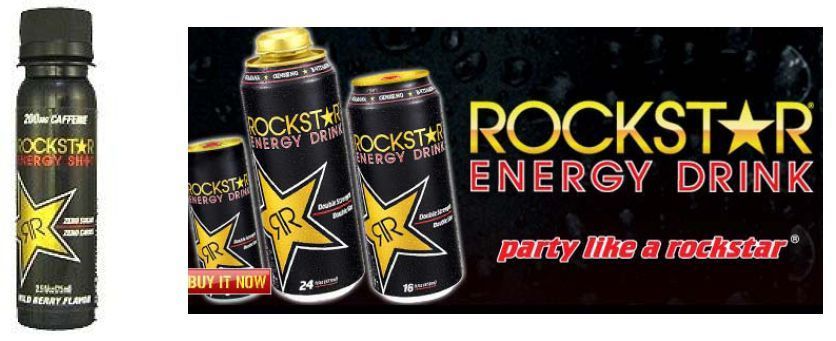
Los Angeles, CA – Energy drink manufacturer Rockstar, Inc. licenses its trademarks from its founder and CEO, Russell G. Weiner. The Rockstar family of trademarks includes Rockstar Energy Drink®, Rockstar®, Party Like a Rockstar®, and the pending Rockstar Energy Shot™. In addition, Rockstar’s promotional materials for its drinks use the tagline “So grab it, shoot it, and Rock ON!” Rockstar alleges that it has sold over one billion cans of its energy drinks and has annual sales of several hundred million dollars. The energy drinks have been sold in containers having the alleged distinctive trade dress depicted below.

trademark-attorney-trade-dress-dring-energy-rockstar.jpg

Defendant Rock On Energy, LLC is accused of using the confusingly similar trademark ROCK ON for a competing energy drink, which is sold by at least one mutual retailer. Also, Defendant is accused of using the confusingly similar “Live Loud. Play Hard. Rock On” tag line for its energy drinks. Further, Defendant allegedly uses a beverage container and product packaging that is confusingly similar to Rockstar’s trade dress. Defendant’s container is mostly black with lettering that is similar in fonts and colors to that of Rockstar’s. The case is Rockstar, Inc. v. Rock On Energy, LLC, CV 09-04017 GAF (C.D. Cal. 2009).

April 30, 2009

Skycam Sues Its Former Engineer For Trade Secret Misappropriation And Trademark And Copyright Infringement

Los Angeles, CA – Skycam manufactures the Emmy award winning aerial camera system that is used to obtain above the action camera shots at sporting events such as the Super Bowl®. Skycam filed suit against Patrick Bennett and Actioncam, LLC for trademark and copyright infringement and trade secret misappropriation.

trademark-attorney-copyright-trade-secret-skycam.jpgPlaintiff alleges it hired Bennett as its chief engineer and provided him with engineering and design documents to work on the next generation of aerial cameras. Although Bennett developed new stabilization algorithms and hardware he was testing, Skycam states that it has not yet publically disclosed or the displayed the innovations. Skycam also alleges that in his position as chief engineer, Bennett was provided access to Skycam’s customer and vendor lists.

In 2006, Bennett and Skycam entered into a Separation Agreement and Release when his employment with Skycam ended, which agreement included a provision for maintaining the confidentiality of all proprietary information. Skycam alleges that “under Bennett’s guidance and with full knowledge of Bennett’s obligation to keep information learned during his prior employment with Skycam confidential, Actioncam utilized the confidential information provided by Bennet to develop” a competing aerial camera system which is marketed to Skycam’s customers. Defendants allegedly posted Skycam’s copyrighted works on their website and used Skycam’s trademark without authorization. The case is Skycam, LLC v. Actioncam, LLC, CV09-02409 PA (C.D. Cal. 2009).

February 25, 2009

Los Angeles Court Grants Factory Five’s Motion To Transfer Venue In Caroll Shelby’s Trade Dress Lawsuit

trade-dress-infringement-lawsuit-type-65-coupe-factory-five-kit-carroll-shelby.bmpLos Angeles, CA – In response to Carroll Shelby’s trademark and trade dress infringement lawsuit (details blogged here), Defendant Factory Five’s attorneys filed a motion to either dismiss the case or transfer venue to the District of Massachusetts (details blogged here). Co-defendant Internet Community Partners, LLC, dba ffcobra.com, joined in Factory Five’s motion.

On February 23, 2009, after the parties’ oral arguments, the Honorable Christina A. Snyder granted Factory Five’s motion and transferred the case to the District of Massachusetts (read the order here), the location of the parties’ previous trademark and trade dress dispute in 2000.

In deciding a motion to transfer, the Court must consider the following three factors: (1) the convenience of the parties; (2) the convenience of the witnesses; and (3) the interests of justice. 28 U.S.C. § 1404(a); see Los Angeles Mem’l Coliseum Comm’n v. NFL, 89 F.R.D. 497, 499 (C.D. Cal. 1981).

In analyzing the “interests of justice,” a number of factors are relevant, including the following: (1) the location where the relevant agreements were negotiated and executed, (2) the state that is most familiar with the governing law, (3) the plaintiff’s choice of forum, (4) the respective parties’ contacts with the forum, (5) the contacts relating to the plaintiff’s cause of action in the chosen forum, (6) the differences in the costs of litigation in the two forums, (7) the availability of compulsory process to compel attendance of unwilling non-party witnesses, and (8) the ease of access to sources of proof. Stewart Org. v. Ricoh Corp., 487 U.S. 22, 29-30 (1988); Jones v. GNC Franchising, Inc., 211 F.3d 495, 498-99 (9th Cir. 2000). Other factors that can be considered are: the enforceability of the judgment; the relative court congestion in the two forums; and which forum would better serve judicial economy. 17 MOORE’S FEDERAL PRACTICE § 111.13[1][c] (3d ed. 1997).

After applying the Ninth Circuit’s legal standard, the Court concluded that the case should be transferred to the District of Massachusetts pursuant to 28 U.S.C. § 1404 because “[t]he 2000 litigation was filed before the instant litigation and the two actions involve substantially similar parties and issues – the crux of both actions is Factory Five’s allegedly unlawful use of the Shelby parties’ marks in the marketing, sale, and distribution of its products. The ‘interests of justice’ are best served by transferring this case to the United States District Court for the District of Massachusetts, which has already dealt extensively with this dispute between the parties.”

Because the Court granted defendants’ motion to transfer venue, the Court declined to reach the merits of defendants’ motion to dismiss.

The case is titled Carroll Shelby v. Factory Five Racing, Inc. et al., CV 08-07881 CAS (C.D. Cal. 2008).

December 31, 2008

F.C. Kingston Sues Kingtech – A Company Started By Former Employees – For Trademark Infringement, Unfair Competition, and Trade Secret Misappropriation

Los Angeles, CA – Trademark attorneys for F.C. Kingston LLC and Storm Manufacturing Group, Inc. (“Kingston”) filed a trademark infringement, unfair competition, and trade secret misappropriation complaint, at the Central District of California (Los Angeles Division), against Kingtech LLC – a company operated by Daniel Marshall and Reed Ferguson, two former Kingston employees. Kingston designs and manufactures “metal valves and custom fittings serving many industries including compressed air, floor cleaning, automotive, medical/dental, industrial flow control, and food service.” Since 1908, Kingston has used the “Kingston” trademark and has obtained a USPTO trademark registration. And starting in 1970 it began stamping its products with a “K” in a circle mark, a trademark application for which is currently pending at the USPTO.

Kingston alleges that Marshall was hired in 2000 as a Quality Engineer and became a Senior Brand Manager in 2005, where, through his job duties, “Marshall had a close relationship with all of Kingston’s suppliers and customers, and was intimately familiar with all of Kingston’s suppliers and customers, and was intimately familiar with the branding of Kingston’s goods and its extensive use of the Kingston Marks.” Plaintiff alleges that Ferguson was hired in 2005 as the national sales manager and worked closely with Marshall “regarding customer acquisition, pricing, promotion, new product development and target market selection.” Both Marshall and Ferguson signed employment agreements in which they agreed that they would not disclose Kingston’s “confidential or proprietary information, including information concerning customer lists, pricing, drawings, and marketing data.” Marshall was allegedly terminated in January of 2008 and Ferguson resigned last June.

Kingston alleges that a few months before resigning, Ferguson asked for and received an Excel spreadsheet providing detailed information about every sale that Kingston had made in the past five years. “Such a compilation of information is obviously not available to the public, and permits its user to know not only who every one of Kingston’s almost 2,000 customers are, but exactly what they have ordered, when they ordered it, and the precise price paid…Ferguson then proceeded to email the entire spreadsheet from his work email account to his personal email account.” The complaint alleges that Ferguson shared the stolen spread sheet with Marshall, who had set up the competing Kingtech business.

A Kingston employee discovered some of the Kingtech products at its customer’s location and later discovered Marshall and Ferguson promoting Kingtech products at an industry tradeshow. “In addition to using a confusingly similar company name, Kingtech stamps its products with a logo that is virtually identical to the Kingston Logo, namely, a circle containing the capital letter ‘K’ with a significantly smaller subscript letter ‘T’.” The complaint provides the following side by side comparison of the parties’ respective products:

trademark-attorney-trade-secret-lawyer-former-employee-fc.jpg

The complaint’s allegations of misconduct do not end there: “To further confuse the market, Kingtech assigned product numbers to its valve products that were nearly identical to the corresponding Kingston valves. For example, Kingtech’s ‘K251-30’ valve was nearly identical to Kingston’s ‘251-30’ valve in form and appearance.” Further, the complaint continues, “Kingtech has also attempted to misappropriate Kingston’s goodwill by slavishly copying non-functional design elements that are unique to Kingston’s products.” Like an infomercial, the complaint has MORE: “further indicative of Kingtech’s bad faith, and in direct violation of the Lanham Act, Kingtech, on multiple occasions, even displayed Kingston’s actual valves on Kingtech’s website.” But wait, there’s even more: “Kingtech has actively sought out and employed Kingston’s production factories in China to produce its essentially identical products bearing the Infringing Marks,” despite Defendants’ knowledge of the Plaintiff’s exclusive distribution agreement with the Chinese factories, which agreement was allegedly negotiated and consummated by Defendant Marshall.” ORDER NOW! Shipping and handling extra. The case is titled F.C. Kingston LLC v. Kingtech LLC et al., CV 08-07904 VBF (C.D. Cal. 2008).

August 4, 2008

Red Bull Filed A Trademark And Unfair Competition Lawsuit Against Mad Dog Energy Drinks – Fair Use May Be A Defense

Los Angeles, CA – Trademark attorneys for Red Bull filed a lawsuit at the Federal District Court in Los Angeles alleging trademark and trade dress infringement, unfair competition under the Lanham Act (15 U.S.C. § 1125), and trademark dilution. The complaint asserts that since Red Bull’s introduction in 1996, over four billion units have been sold in the United States and over one billion dollars have been spent on advertising, marketing and promoting the Red Bull energy drink. Red Bull has obtained trademark registrations at the U.S. Patent & Trademark Office for the its word marks in addition to the trade dress in its can designs.

trademark-attorney-in-los-angeles-fair-use-foosh.jpgThe Defendants manufacture and sell chocolate mint chews bearing the “Buzz Bites” trademark and mints bearing the “Foosh Energy Mints” trademark. Red Bull is not concerned about the word marks used by Defendants, but alleges that the Defendants’ use of Red Bull’s trademarks and trade dress in Defendants’ advertising and on Defendants’ website and vending machines “is likely to cause confusion before and during the time of purchase of defendants’ products because purchasers, prospective purchasers . . . are likely to be drawn to defendants’ products because they mistakenly attribute [defendants’] products to Red Bull.” Red Bull sent a cease and desist letter to Defendants, but Defendants have allegedly refused to cease the use of the Red Bull trademarks and trade dress. The case is titled Red Bull GMBH v. Vroom Foods, Inc. and Mad Dog Energy Products, CV08-04960 GAF (C.D. Cal. 2008).

PRACTICE NOTE: A competitor can assert the nominative fair use defense to protect its ability to use a trademark to refer to a trademark owner or its goods or services for purposes of reporting, commentary, criticism, and parody, as well as for comparative advertising. To qualify for the nominative fair use defense, the following three requirements must be met: (1) the trademark owner, product, or service must not be readily identifiable without use of the trademark; (2) the defendant must use only as much of the mark as is necessary to identify the trademark owner, product, or service; and (3) the defendant must do nothing that would suggest sponsorship or endorsement by the trademark owner. From the facts asserted in the complaint, the Defendants will probably interject a comparative advertising fair use defense, because they are comparing the caffeine content of their product and that of Red Bull. It appears that the first and third elements of the test are met, but the defense will probably turn on whether the second element of the test is satisfied - i.e. did Defendants use more of Red Bull's trademarks/trade dress than was necessary to make the comparison?

March 5, 2008

Trade Secrets Misappropriation & Trade Dress Infringement Litigation Commenced In A Mother-Against-Daughter Lawsuit Over The Little Giraffe Trademark And Business

Los Angeles, CA – A mother-daughter team founded The Little Giraffe, Inc. to manufacture baby and adult accessories, apparel and giftware under the trademarks, registered with the USPTO, of “Little Giraffe” and “Giraffe at Home.” The mother, Marcia Brower, and the daughter, Sharyn Brower Newberg, were each a 50 percent owner of the shares of the corporation. The complaint alleges that the daughter breached her fiduciary duty to the company and used company checks to “pay personal expenses, wiring funds from the corporate account to pay her credit card bills, selling Little Giraffe inventory for her own account, purging vital information from her computer at company headquarters, and removing vital fabric samples and company property.” The complaint continues that the daughter, “with the help of her co-defendants, secretly took steps to set up a company to compete against Little Giraffe under the name ‘Votre Luxe,’ intentionally copying the distinctive look and feel of Little Giraffe’s products,” including the trade Dress, trade secrets, and proprietary business information.

little%20giraffe.jpgPlaintiff asserts that its trade dress includes the appearance of its products, including “the shape and dimensions of satin trim to plush fabric,” “the color combinations of various fabrications,” “the texture of its plush or luxury fabrics,” “the patterns of Little Giraffe’s robes,” color coordinated pieces to the colors of the products of Little Giraffe, and the placement location of the Little Giraffe logo. Plaintiff also asserts that its trade secrets include “vendors and suppliers of fabric and trim, its know-how concerning the manufacturing process,” “the cutting and sewing contractors” it uses in the manufacturing process, its vendor lists, customer lists, and proprietary financial documents. Plaintiff alleges that her daughter, in association with co-defendant “Rosalie & Friends, Inc. has displayed and offered for sale Votre Luxe’s line of products that are confusingly similar to the products Little giraffe manufactures and sells.”

The complaint sets forth the following six causes of action: (1) Breach of Fiduciary Duty, (2) Trade Dress Infringement Lanham Act 43(a), 15 U.S.C. § 1125, (3) Trade Secrets Misappropriation, (4) Conversion, (5) Unfair Competition Under Cal. Bus. & Prof. Code § 17200, and (6) Injunctive relief. The case is titled: Marcia Brower v. The Little Giraffe, Inc., CV08-01111 PSG (C.D. California).

PRACTICE NOTE: This case illustrates the importance of written agreements in business partnerships, even if you are doing business with a family member.