February 13, 2012

Knicks’ Jeremy Lin Should Block Unauthorized Linsantity Trademark Filing At USPTO

jeremy-lin-chinese-american-nba-knicks-trademark-linsanity-unauthorized.jpgThis NBA season’s “LIN-derella” feel good story is New York Knicks’ Jeremy Lin’s fast-break rise from bench warmer to player of the week award recipient in a week. With his success, the nicknames have started pouring in faster than the 38 points he scored against the Lakers: LINsanity, LINcredible, LINvincible, LINsational, Super LINtendo, and my favorite, Duhhh LINning (à la Charlie Sheen). Lin is so popular right now that even the Knicks’ page on nba.com is dedicated to Lin and his new iPhone app. Lin’s popularity cannot be contested because I’m even writing about him. Well, I got carried away with all the hype.

But along with the upside of fame comes unauthorized, third-party trademark applicants. A search of the USPTO’s trademark database shows an application filed only six days ago by an unrelated party, Yenchin Chang, to register the “LINsanity” trademark for use on a slew of goods including athletic uniforms, t-shirts, baseball caps and hats, etc. I hope that Mr. Chang does not expect to LIN (yes, that was bad). Trademark law prevents registration of a mark that “consists of or comprises a name, portrait, or signature identifying a particular living individual except by his written consent.” 15 U.S.C. § 1052(c).

For example, the USPTO’s Trademark Trial and Appeal Board affirmed the trademark examining attorney’s refusal to register the trademarks “Obama Pajama” and “Barack’s Jocks Dress To The Left” because applicant failed to provide President Barack Obama’s written consent. In re Richard M. Hoefflin, 97 USPQ2d 1174 (TTAB 2010) [precedential]. To determine “whether a particular living person bearing the “name” would be associated with the mark as being used on the goods, we must consider (1) if the person is so well known that the public would reasonably assume the connection, or (2) if the individual is publicly connected with the business in which the mark is being used.” The trademark examining attorney – unless she’s been hiding under a rock this past week or is a Nets fan – should refuse registration because trademark law prevents even nicknames that identify a particular living individual from being registered without their consent.

Assuming that the trademark examining attorney is a Nets fan and does not refuse registration, all is not lost for number 17. In the trademark application process, following the examining attorney's review and approval, it is published for thirty days and any party that believes he or she may be harmed by the registration can file an opposition to prevent registration. Further assuming that Jeremy Lin misses the opposition period and the trademark registers, which is unlikely for the Harvard grad, he can still file a proceeding at the USPTO or a lawsuit in federal court seeking cancellation of the unauthorized registration.

October 29, 2009

Tag Toys Tags LeapFrog With Trademark Infringement Lawsuit Over Educational Toys

trademark-attorney-toy-tag-toys-leapfrog-trademark-infringement.jpgLos Angeles, CA – Tag Toys, Inc. (“BBI”) sued LeapFrog Enterprises, Inc. for trademark infringement, trademark dilution, and unfair competition under the Lanham Act § 43(a). Tag designs and manufactures infant and children’s toys that are sold throughout the U.S. under its TAG and/or “TAG THINK & GROW” trademarks, which marks have allegedly been used since 1979. Tag Toys has registered its trademarks with the U.S. Patent & Trademark Office and, because they have been registered for over five years, they have become incontestable.

Tag Toys accuses LeapFrog of using confusingly similar “Tag” trademarks on children’s toys that are marketed through the same channels. Tag alleges that LeapFrog filed a trademark application with the USPTO for its own “TAG” trademark, which application was refused registration by the Trademark Examining Attorney due to the existence of a likelihood of confusion with Tag Toys’ previously registered trademarks. Thus, Tag Toys alleges, LeapFrog was aware of Tag’s senior rights in the mark. The case is Tag Toys, Inc. v. LeapFrog Enterprises, Inc., CV 09-07528 GHK (C.D. Cal. 2009).

August 13, 2009

Rebranding - Loss of Identity vs. Invigoration

CNN Money has an interesting article (link here) regarding several companies' attempts to invigorate their image by using new logos. Some have succeeded (e.g. Apple) and some, well, not so much (e.g. Xerox). Although re-branding is a bit of a gamble with consumers, having a strong word mark as a fall-back measure reduces the risks.

apple-old-new-logos-trademark-rebranding-branding.jpg

April 24, 2008

TTAB Affirms Refusal To Register Stitching On Jeans’ Pockets As Trademark – Merely Ornamental And Not Inherently Distinctive

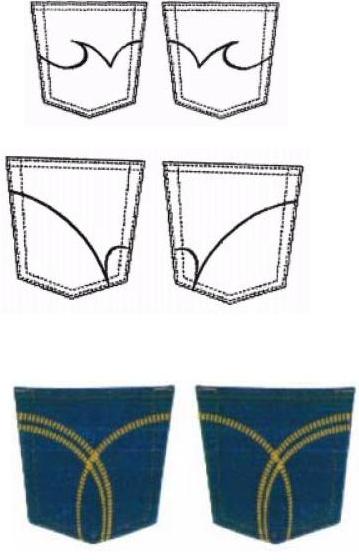
The Trademark Trial And Appeal Board (“TTAB”) issued a ruling in In re Right-On Co., Ltd., affirming the examining attorney’s refusal to register Right-On’s three trademark applications, covering stitching on the back pockets of jeans, because they were a form of ornamentation and were not inherently distinctive to function as trademarks. Click HERE To Read The Opinion.

jeans-stitching.jpgRight-On filed applications to register as trademarks on the Principal Register the pocket-stitching designs shown to the right for various apparel and garment goods. The focus of the appeal to the TTAB was restricted to jeans only. All three applications were based on a request for extension of protection under Section 66(a) of the Trademark Act, 15 U.S.C. §1141f(a) or, in other words, extension to the United States was sought from an international registration. The Examining Attorney refused registration of the pocket-stitching designs because they are “decorative or [] ornamental feature[s] of the goods that are not inherently distinctive and thus would not be perceived as [] mark[s] by the purchasing public without further evidence of acquired distinctiveness.” The applicant, surprisingly, “elected not to attempt a claim of acquired distinctiveness under section 2(f)” but instead appealed the final refusal to the TTAB.

The TTAB judges were not persuaded by the applicant’s argument that other stitching-designs on jeans have been held inherently distinctive and registerable, noting that each case must be decided on its own set of facts. Applicant’s arguments and citations to other allowed trademarks “provides little insight other than to indicate that pocket stitching designs have sometimes been found to be inherently distinctive and sometimes found not to be inherently distinctive.”

In considering the facts of the instant applications and the designs, the TTAB judges ruled that “Applicant’s argument that its designs are not common is not supported by the record. There are a multitude of variations of arches, checks, swoops, waves and other linear designs registered or in use on jeans pockets. They are in no way ‘elaborate and unique.’” The TTAB, however, did indicate that the applicant may have been able to register it’s stitching trademark based upon acquired distinctiveness, which it chose not to do.

PRACTICE NOTE: If you intend to use pocket-stitching on jeans as a trademark, it is highly unlikely that adopting geometric shapes and lines will qualify as an inherently distinctive trademark. Thus, it is better to use elaborate and unique designs that are inherently distinctive and entitled to immediate registration, which designs may also be protectable through copyright registration. I previously posted here about a jean pocket-stitching design which was both copyrighted and a registered trademark.

February 13, 2008

TTAB - Trademark Action Filed By Yoko Ono To Cancel “Lennon” Trademark Based On Likelihood Of Dilution Of John Lennon Trademark Registrations

A trademark cancellation proceeding – which is similar to a lawsuit – was filed at the Trademark Trial and Appeal Board (TTAB) by John Lennon’s widow, Yoko Ono, against Lennon Murphy, the registrant of the “Lennon” trademark. Murphy, a musician, filed an “intent to use” trademark application with the United States Patent and Trademark Office (USPTO) for the trademark “LENNON” on April 11, 2001. The trademark application was published on October 29, 2002 and was registered on January 21, 2003.

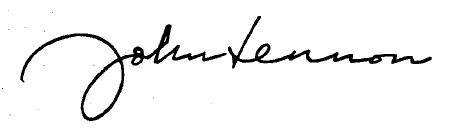
JohnLennon.bmpOno alleges that she is the owner of two registered trademarks for “John Lennon” (although she fails to disclose that they are for a design – John’s signature pictured to the left – and not a word mark) for use with “paper products, tote bags and address books” and “eyewear and eyewear accessories.” Murphy’s registration, on the other hand, is for the use of the “Lennon” trademark on musical sound recordings and entertainment services by a musical group.

Ono alleges that the use of the “Lennon” trademark will dilute, either by blurring or tarnishment, the power of her John Lennon trademarks. Ono further alleges that Murphy committed fraud on the USPTO in her application by not disclosing that “Lennon” was her first name and that Murphy lied to the USPTO when she stated that she began using the trademark in 1997, at the age of 15. Click To Read Ono's Filing.

PRACTICE NOTE: It seems that Ono may run into a laches issue because she waited over five years from the date of publication to file the cancellation proceeding. See Turner v. Hops Grill & Bar, Inc., 52 U.S.P.Q.2d 1310 (T.T.A.B. 1999) (finding laches in cancellation proceeding with five-year delay between publication for opposition and filing of petition to cancel); National Cable Television Association Inc. v. American Cinema Editors Inc., 937 F.2d 1572, 1580, 19 USPQ2d 1424, 1432 (Fed. Cir. 1991) (holding that laches defense is applicable to TTAB proceedings and the time begins to run from the date of publication of the trademark for opposition). According to Murphy’s website, her manager – who ironically is the son of Ono’s attorney – approached Ono in 2000 to clear the use of the “Lennon” trademark and received her blessing. An undue delay in asserting your rights may prevent recovery under the equitable defense of laches.

February 9, 2008

Trademark v. Domain Name: USPTO Registered Trademark Owner Loses Domain Name Arbitration – UDRP/ICANN

Filing a trademark application with the USPTO for a descriptive trademark does not provide enforceable trademark rights until secondary meaning can be established, after which the trademark can be registered on the principal register from the supplemental register. The trademark owner learned the drawbacks of choosing a descriptive trademark when attempting to enforce its trademark rights against a domain name registrant in a National Arbitration Ruling that was filed under the Uniform Domain-Name Dispute-Resolution Policy ("UDRP").

Complainant trademark owner B&V Associates, Inc. filed a trademark application for its ewaterways.com trademark on July 26, 2000. However, because the USPTO deemed the mark was merely descriptive of applicant’s services, B&V amended its application to seek registration under Trademark Act Section 2(f), 15 U.S.C. Section 1052(f), based on acquired distinctiveness as a result of continued and exclusive use since 1996. On June 18, 1999, a year before B&V’s trademark application was filed, Respondent registered the ewaterway.com domain name. The Panel found that at the time of Respondent’s domain name registration, Complainant, as admitted by its Section 2(f) filing with the USPTO, had not established trademark rights because it had not acquired distinctiveness. Accordingly, because Complainant did not meet the initial burden of presenting a sufficient prima facie case showing of enforceable rights in the trademark at the time of the domain name filing, the Panel denied cancellation or transfer of the domain name. Click To Read The Decision.

PRACTICE NOTE: It is best to adopt a trademark that is immediately protectable and enforceable. Descriptive trademarks are not immediately protectable and require a showing of acquired distinctiveness. Click To Read Suggestions On Selecting A Proper Trademark.

February 7, 2008

Domain Name v. Registered Trademark: Transfer of Domain Name Constitutes New Registration And Trademark Rights Established Before Transfer Results In Transfer For Trademark Owner Complainant

WIPO domain name arbitration under the UDRP provides a thorough analysis of a domain name registrant’s rights and those of trademark owners. In HSBC Finance Corporation v. Clear Blue Sky, Inc., Case No. D2007-0062, Complainant HSBC had registered the trademarks CREDITKEEPER and CREDIT KEEPER (plus design) with the USPTO on July 13, 2004 and November 22, 2005, respectively. The domain name in dispute was initially registered by Peter Bradford on January 24, 2001 – prior to HSBC’s trademark registrations. On December 15, 2004, after HSBC’s trademark had already registered, Respondent Clear Blue Sky acquired the disputed domain name from Bradford for the sum of $48,000.

creditkeeper.gifClear Blue Sky argued that it should benefit from Bradford’s earlier domain name registration because it acquired all rights and interests through a written assignment and denied bad faith registration and use of the domain name. Paragraph 4(a) of the Policy requires that the Complainant prove three elements to obtain a decision that a domain name should be either cancelled or transferred, one of which includes that “the domain name has been registered and is being used in bad faith.” In rejecting Respondent’s “relation back” theory, the Panel found that:

The consensus view of WIPO Panelists is that, while a renewal of a domain name does not amount to registration for purposes of determining bad faith, the transfer of a domain name to a third party does amount to a new registration, requiring the issue of bad faith registration to be determined at the time the current registrant took possession of the domain name.

The Panel also found that HSBC had established a prima facie case of bad faith registration and that Blue Sky had not met its burden of countering with evidence to show its good faith. The Panel noted that the initial registration occurred before HSBC trademark rights were established. But after HSBC launched the mycreditkeeper.com domain, the initial registrant posted pay-per-click ads on its parked domain with similar subject matter. And, eight months after HSBC’s launch, Blue Sky purchased the subject domain for a substantial sum of $48,000, presumably, in hopes of selling it to HSBC at a much higher price. As a result, the Panel ordered that the domain name be transferred to HSBC.

PRACTICE NOTE: The Anti Cyber-Piracy Act, 15 U.S.C. 1125(d), allows domain name disputes to also be filed in U.S. Federal District Courts. The advantage of filing a Federal District Court action is the availability of statutory damages of at least $1,000 and not more than $100,000 per domain name. Attorneys’ fees and costs are also available under 15 U.S.C. 1117.

February 6, 2008

Trademark Application/Infringement – Article From The New York Post

In my previous post, I discussed the Patriot’s trademark application filing for “19-0 The Perfect Season,” and the New York Post’s retaliatory, and possibly clairvoyant, “18-1” trademark application. I was interviewed by New York Post reporter, Charles Bennet, regarding the trademark issues surrounding the now more relevant “18-1” trademark and was quoted in his newspaper article. Click HERE to read the NY Post article.nypmasthead2.gif

February 5, 2008

Trademark Search Prior To Adoption Of Trademark Would Have Likely Staved Off Preliminary Injunction And Avoided Litigation

Palantir.net began using the “palantir” trademark in 1996 for providing website design and development services nationally and registered the domain name in 1997. Palantir.net also filed a trademark application in 2002 with the USPTO, which registration issued in 2006. In early 2007, Palantir.net discovered Palantir Technologies, Inc. (“PTI”) was using the “palantir” trademark for designing database software for others and hiring interaction designers and software engineers, similar to Palantir.net. Palantir.net also learned that PTI was using the “palantir” trademark for Google’s AdWords service to pay for sponsored search results for the word “palantir” on Google.

palantir_logo.gif Palantir.net moved for a preliminary injunction to stop PTI’s use of the trademark “palantir” in advertising its services. The California Northern District Court granted the preliminary injunction and found that: “Palantir.net has easily proven the existence of serious questions going to the merits; indeed, the Court finds that it has also demonstrated a probable success on the merits given (1) the virtual identity of the marks, (2) the strength of the mark, (3) the relatedness of the goods, and (4) both parties’ use of the Internet.”

The Court also found that the balance of hardships also tips sharply in Palantir.net’s favor because of PTI’s recklessness in adopting the “palantir” trademark without first searching for any similar trademarks, Palantir.net’s long-time use of the mark, and the importance of the trademark to word-of-mouth referrals. The Court ordered that PTI not use “palantir” in any Google ads and to place prominent disclaimers on its website disclaiming any affiliation with Palantir.net and advising visitors how to access Palantir.net. Click To Read Order.

PRACTICE NOTE: A trademark search and legal availability opinion are a relatively inexpensive way to determine whether there are any conflicting trademarks that should be avoided. This slight initial expense will avoid possible litigation and an interruption to your business and advertising. Click Here To Read Suggestions On Selecting A Proper Trademark.

February 4, 2008

Patent-Trademark-Copyright: Dubai Hosts World Intellectual Property Organization (“WIPO”) Global Anti Counterfeiting and Piracy Congress

Patents, trademarks and copyrights and counterfeiting will be at the forefront at the WIPO’s Fourth Global Congress on Combating Counterfeiting and Piracy that meets in Dubai from February 3-5, 2008. The meeting is to focus on the following key themes:

  • Health and Safety Risks Counterfeit Products Pose to Consumers;
  • Raising Awareness of the Full Economic and Social Costs of Counterfeiting and Piracy;
  • The Growing Problem of the Sale of Counterfeit and Pirated Products over the Internet; and,
  • Strengthening Cooperation and Collaboration at the Global Level.

“The Congress will bring together policy makers and experts from more than 60 countries to explore and identify concrete measures and resources to counter the damaging effects of the illegal trade in counterfeit and pirated goods.” Click To Read The WIPO Announcement.