 Los Angeles Intellectual Property Trademark Attorney Blog


A Redondo Beach, CA restaurant was sued for copyright infringement by copyright attorneys for several recording companies for publicly playing music at the restaurant without a license from ASCAP, BMI, or SESAC. The complaint lists five songs which received copyright registrations by their individual authors with the U.S. Copyright Office, and the rights are owned by the record companies. The complaint alleges that on one night, presumably when their investigator was at Paulie’s Upper Deck Sports Grill, the five musical compositions covered by copyrights were publicly performed “for the entertainment and amusement of the patrons attending said premises, and defendants threaten to continue such infringing performances.”
The complaint alleges that plaintiff warned the defendant that a copyright license was needed in order to publicly perform the music at the restaurant. Because the defendant allegedly refused to pay for the license, the defendant’s copyright infringement was intentional and willful. Plaintiffs request statutory damages under 17 U.S.C. § 504(c)(1), of not more than $ 30,000.00 and not less than $ 750.00 for each registered song. Plaintiffs also request that the court order the defendants to pay the costs of the lawsuit and reasonable attorneys’ fees pursuant to 17 U.S.C. § 505. The case is titled: Far Out Music v. Fratelli Brothers, Inc., CV08-01975 GPS (C.D. California).
PRACTICE NOTE: 17 U.S.C. 504(c)(2) allows the statutory damages to be raised to $150,000.00 per infringement if it is deemed to be knowingly conducted. Also, if a restaurant or public establishment unreasonably believed that it was exempt from licensing requirements under 17 U.S.C. § 110(5), the copyright plaintiff, in addition to other damages under section 504, will be entitled to two times the license fee which it should have paid for the preceding period of up to 3 years. Because of the varying affiliations between record companies and the licensing society, a license from each of the following licensing societies must be obtained to cover the music owned by the various recording companies:
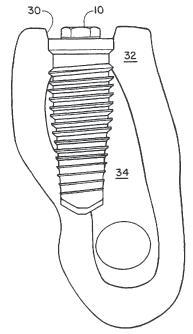 The complaint alleges that defendant “Blue Sky first began using the Nobel, Nobel Biocare, Replace, Nobelreplace, and Nobelguide marks in connection with the sale and promotion of its [dental] goods in February of 200, long after [Plaintiff] Nobel had commenced its substantial use and promotion of its” Nobel trademarks and long after it had registered the trademarks with the USPTO. The complaint alleges infringement of the ‘160 patent and the ‘361 patent. It also alleges infringement of registered trademarks under 15 U.S.C. § 1114. False designation of origin is asserted under section 43(a) of the Lanham Act, 15 U.S.C. § 1125(a) and dilution of trademarks under 15 U.S.C. § 1125(c)(1). California causes of action are asserted for unfair competition under Cal. Bus. & Prof. Code § 17200 and common law trademark infringement. The case is titled Nobel Biocare USA, LLC v. Blue Sky Bio, LLC, CV08-01407 ODW (C.D. California).
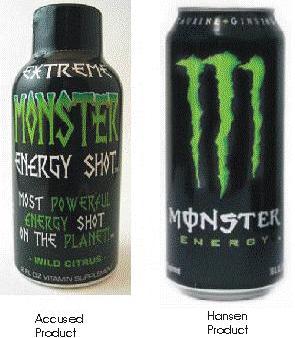 Defendants also sell an energy product under the trademark of Monster Energy Shot. Hansen alleges that “without permission or authority from Hansen, Defendants have infringed Hansen’s MONSTER Marks in interstate commerce in connection with Defendants’ making, using, promoting, advertising, selling, and/or offering to sell the MONSTER ENERGY SHOT drink.” The complaint also states that, by choosing a similar color scheme on their containers, “Defendants have infringed Hansen’s MONSTER trade dress in interstate commerce in connection with Defendants’ making, using, promoting, advertising, selling, and/or offering to sell its MONSTER ENERGY SHOT energy drink.” The complaint asserts the following causes of action: (1) Trademark infringement 15 U.S.C. §§ 1114; (2) Trademark dilution under the Lanham Act section 43(c), 15 U.S.C. § 1125(c); (3) False designation of origin and trade dress infringement under section 43(a) of the Lanham Act, 15 U.S.C. § 1125(a); (4) California trademark dilution under Cal. Bus. & Prof. Code § 14330; (5) Unfair competition under Cal. Bus. & Prof. Code §§ 17200 and 17500; (6) Common law trademark infringement; (7) Common law trade dress infringement; and, (8) California common law unfair competiton. The case is titled Hansen Beverage Company v. N2G Distributing, Inc., et al., EDCV08-0357 VAP (C.D. California).
 The defendant is alleged to have “registered and/or used over four million (4,000,000) domain names.” Plaintiffs allege that the defendant has used an automated process to register domain names that are confusingly similar to the Neiman Marcus registered trademarks. The domain names are numerous misspellings of the trademarks. The complaint alleges that the defendant’s “typo-squatting” tactics are also used to cybersquat on other famous trademarks. The defendant allegedly provides pop-up and pop-under advertisements to be displayed on the confusingly similar domain names and defendant makes income from the pay-per-click advertisements. The complaint alleges the following causes of action: (1) Cybersquatting under 15 U.S.C. § 1125(d); (2) Trademark infringement 15 U.S.C. §§ 1114; (3) Unfair competition and false designation of origin under section 43(a) of the Lanham Act, 15 U.S.C. § 1125(a); (4) Trademark dilution under the Lanham Act section 43(c), 15 U.S.C. § 1125(c); (4) Trademark infringement under Cal. Bus. & Prof. Code § 14320; and, (5) Unfair competition under Cal. Bus. & Prof. Code §§ 17200 and 17500. The case is titled The Neiman Marcus Group, Inc. v. Ultra RPM, Inc., CV08-01723 MMM (C.D. California).
 Dell alleges that the four individual defendants enrolled in Dell’s reseller program and became bound by the resale terms, where “defendants agreed (1) to refrain from unauthorized use of Dell’s trademarks; (2) not to resell Dell product without first adding value through the addition of hardware, software, or services; (3) not to resell Dell product on auction-type websites [such as eBay]; and (4) to resell their Dell product to small and medium businesses.” The complaint alleges that the defendants have used aliases to purchase Dell products and sold them through unauthorized trade channels and on eBay in violation of the reseller agreement and have made misrepresentations and misused Dell’s trademarks. For example, the defendants have allegedly sold products on eBay as “new” when they were, in fact, refurbished. The complaint asserts that “Defendants have, through their scheme of deliberate misrepresentation and concealment, purchased millions of dollars worth of Dell products from Dell and resold such product in breach of their contractual obligations to Dell and in violation of Dell’s trademark rights.” The complaint alleges the following causes of action: (1) Trademark counterfeiting and infringement 15 U.S.C. §§ 1114; (2) Unfair competition and false advertising under section 43(a) of the Lanham Act, 15 U.S.C. § 1125(a); (3) Trademark dilution under the Lanham Act section 43, 15 U.S.C. § 1125(c); (4) Unfair competition and false advertising under Cal. Bus. & Prof. Code §§ 17200 and 17500; (5) Unjust enrichment; (6) Breach of contract; (7) Fraud; and, (8) Civil conspiracy. The case is titled Dell, Inc. v. Kizun, et al., CV08-01821 JSL (C.D. California)
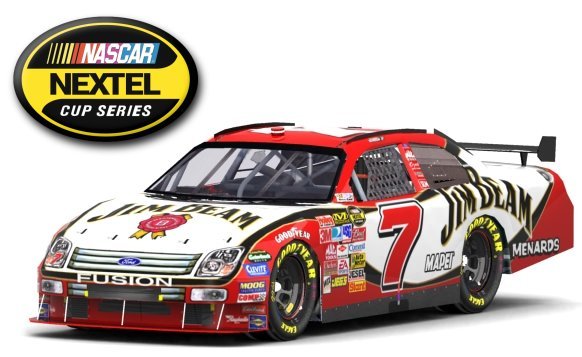 For the 2008 racing season, Camping World and Robby Gordon Motorsports entered into another sponsorship agreement where “Camping World agreed to provide two motor coaches and pay [Gordon] $200,000 per race for primary car sponsorship for four NASCAR Sprint Cup races.” The complaint alleges that Camping world has partially performed its obligations by providing one of the two motor coaches, but is now refusing to provide the second motor coach. The complaint continues that Camping World sought to renege the sponsorship agreement by demanding that Robby Gordon “ensure that Camping World’s colors and logos do not appear on [Gordon’s] car…and Gordon does not have [Camping World’s] permission to bear [Camping World’s] trademarks.” Also, Camping World has allegedly failed to pay at least $250,000 due under the sponsorship agreement. Robby Gordon Motorsports requests monetary damages for the alleged breach of contract and the Court’s determination of the rights of the parties with respect to the trademarks. The case is titled Team Gordon, Inc. v. Camping World, Inc., CV08-01731 MMM (C.D. California).
 Burbank, CA – Copyright attorney files copyright infringement lawsuit in