 Los Angeles Intellectual Property Trademark Attorney Blog


A copyright infringement, trade dress infringement (Lanham Act 43(a), 15 U.S.C. 1125), and unfair competition lawsuit was filed by luxury jeweler Van Cleef & Arpels against supermodel Heidi Klum’s company and jewelry designer Mouawad USA, Inc. in Federal District Court in New York in December of 2007. The complaint alleges that for almost forty years, Van Cleef “has marketed the Alhambra collection of jewelry, which has become world renowned for its distinctive well-recognized design.” Van Cleef alleges that it is the owner of all copyrights in the subject designs and, through extensive advertising and promotion of the Alhambra collection, it has established secondary meaning and distinctiveness therein. Jewelry copyright registrations are relatively inexpensive and afford robust protections and damages.
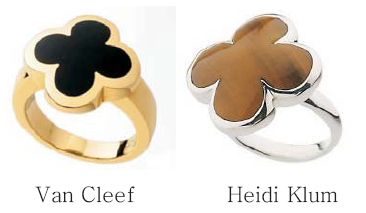 Van Cleef alleges that defendants intentionally and willfully copied the Alhambra designs, which mainly feature a four leaf clover. Van Cleef continues that defendants, by appropriating the goodwill built up by plaintiff are causing confusion in the market place, in that consumers are often confused between the plaintiff’s designs and those of defendants.
It now appears that the lawsuit is going to be settled even before the Defendants file an answer to Van Cleef’s allegations. On February 13, 2008, the parties asked the Court to adjourn the initial conference from February to April while they negotiate a settlement of the case.
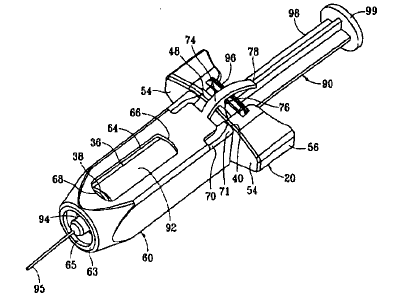 Safety Syringes asserted the same three patents, Nos. 6,613,022, 7,101,355, and 7,300,420, in Los Angeles District Court in April of 2007 against Plastef. That case is titled: Safety Syringes, Inc. v. Plastef Investissements, 07-CV-2307 (C.D. CA 2007). Sanofi alleges that it imports and uses a needle safety shield device that is similar to the device in the Plastef case. Thus, because Safety Syringes has asserted claims of inducement and contributory patent infringement in the Plastef case, Sanofi-Aventis believes that it is being accused of infringing the three patents and that an actual controversy exists between the parties. Sanofi alleges that Safety Syringes has put Sanofi in a “position of pursuing behavior that [Safety Syringes] would allege constitutes an infringement or of abandoning a course of action which Aventis believes it has a lawful right to pursue.”
 The Panel found that the medical company’s trademark and the misspelled domain name were confusingly similar. Also, the pay-per-click advertising on the parked website targeted the same consumers based upon offers for competing medical equipment and the registrant did not have any rights or interests in the confusingly similar trademark. Further, the Panel found that the domain was registered in bad faith because it was registered after the trademark application was filed and offered similar products through pay-per-click ads. Thus, the Panel ruled that the registration “was an act of typo squatting and was calculated to confuse Internet users as to the source of and to take commercial advantage of the Complainant’s rights in the LAERDAL trademark.”
 On February 4, 2008, the Court denied most of Microsoft’s requests. The Court ruled that it was not persuaded that Microsoft did not breach its agreement and that Veritas had presented enough evidence to establish its trade secret rights in the private interfaces and other information. The Court also noted that Veritas had provided credible evidence of bad faith, one in the form of an email summarizing a statement by one of Microsoft’s managers on the project, who admitted that:
 On an emergency motion by EchoStar, the Court of Appeals for the Federal Circuit (“CAFC”) stayed the permanent injunction pending the outcome of the appeal. On January 31, 2008, although the CAFC agreed with EchoStar that it did not infringe on the hardware claims, the CAFC upheld the infringement of the software claims. The CAFC explained that because the jury had not segregated the damages award along the hardware and software claims, the $73.9 Million award still stood. In fact, the CAFC instructed the lower court to increase the monetary award based on EchoStar’s continuing infringement while the lower court’s judgment was stayed.