February 11, 2012

Court Shoots Down Strip Club’s Rhino Trademark Lawsuit Against Gun Company

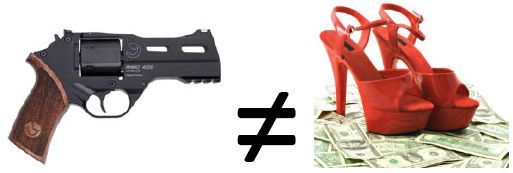
trademark-dismiss-confusion-spearmint-rhino-chiappa-firearms-gun.jpgIn an opinion that shocked no one except Spearmint Rhino, the Court dismissed WITH PREJUDICE – a rarity at such an early stage in litigation – the strip club operator’s trademark infringement case against Chiappa Firearms. Spearmint sued Chiappa for using a rhino outline as a trademark on its guns alleging that its use is “likely to cause confusion, or to cause mistake, or to deceive because, among other reasons, consumers are likely to believe that there is an affiliation, connection, or association between” Spearmint and Chiappa. As predicted, the Court disagreed with Spearmint because consumers are unlikely to confuse its G-strings with guns.

Chiappa filed a motion to dismiss the complaint, wherein the court is requested to decide whether, assuming all the allegations in the complaint are true, the plaintiff has still failed to present a case entitling it to damages. The Court, however, must consider whether the claim is plausible on its face based on alleged facts. Thus, a complaint which alleges only labels and conclusions to meet the elements of the cause of action will not survive dismissal. Bell Atl. Corp. v. Twombly, 550 U.S. 544 (2007).

To prevail on its trademark infringement claim, Spearmint had to show that it had a protectable trademark and that a “reasonably prudent consumer” is likely to be confused as to the origin of a good or service. DreamWerks Production Group, Inc. v. SKG Studio, 142 F.3d 1127 (9th Cir. 1992). To evaluate likelihood of confusion, Courts analyze the following non-exhaustive factors including: (1) strength of the mark; (2) relatedness to the goods; (3) similarity of sight, sound, and meaning; (4) evidence of actual confusion; (5) marketing channels; (6) type of goods and purchaser care; (7) intent; and (8) likelihood of expansion. AMF, Inc. v. Sleekcraft Boats, 559 F.2d 341 (9th Cir. 1979).

Courts, as here, do not have to blindly believe the infringement allegations because a plaintiff has to show that likelihood of confusion must “be probable, not simply a possibility.” Murray v. Cable NBC, 82 F.3d 861 (9th Cir. 1996). If not shown, the Court may determine that likelihood of confusion does not exist as a matter of law. Toho Co. v. Sears, Roebuck & Co., 645 F.2d 788 (9th Cir. 1981).

The Court determined that Spearmint could not establish likelihood of confusion because “Plaintiff has not been able to demonstrate a single instance of actual consumer confusion, and indeed cannot show that any reasonable consumer is likely to be confused as to the relationship between these two companies. Plaintiff mainly provides services in the form of adult entertainment, while Defendants mainly provide goods in the form of handguns. It is highly unlikely that a consumer would accidentally purchase one when he intended to purchase the other.” In other words, because consumers are unlikely to be confused and shoot each other with G-strings, Spearmint’s trademark infringement claim failed as a matter of law. So, like clay pigeons, fell Spearmint’s false designation of origin and §17200 unfair competition claims.

Spearmint’s trademark dilution claim also fell in the Court’s crosshairs because although Rhino introduced evidence that its mark was “at least somewhat well known, it fails to assert sufficient facts to support a finding that the Rhino mark is famous under the Trademark Dilution Revision Act of 2006. Courts have consistently held that only the most truly prominent brands, such as Kodak, Coca Cola, Budweiser, or Barbie count as famous under the statute.”

The case is Spearmint Rhino Companies Worldwide, Inc. v. Chiappa Firearms, Ltd., et al., CV11-05682 R (C.D. Cal. 2011).

November 28, 2011

Twilight’s Bella Swan Wins Trademark and Copyright Infringement Lawsuit Over Jacket

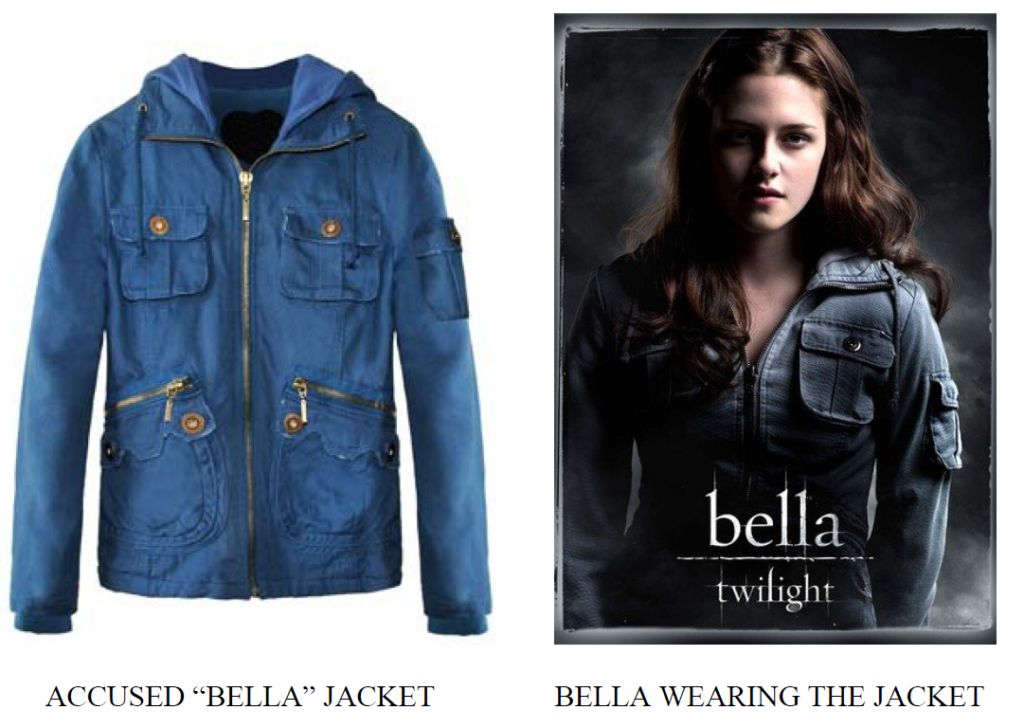
Before last week’s release of Twilight Saga: Breaking Dawn Part 1, a trademark and copyright infringement lawsuit saga dawned on clothing manufacturer B.B. Dakota over the pictured Bella Jacket. Summit Entertainment, the producer of the Twilight franchise that has raked in more than $1 billion in gross revenues, owns several USPTO trademark registrations for the “TWILIGHT” and “BELLA” trademarks, including for use on clothing and jewelry. Summit of course also owns all copyrights in the movies in addition to marketing and publicity materials and the “Bella Trading Card Image.” Summit’s licensing of the intellectual property rights has grossed an additional $63 million.

twilight-bella-jacket-trademark-copyright-infringement-lawsuit-attorney.jpg

Defendant BB is a clothing manufacturer that sold the pictured women’s cargo jacket in 2006 under the “Leigh” mark, which was discontinued in 2008. When the Leigh jacket was worn by Bella in the 2009 Twilight movie, BB was credited as the manufacturer in an Entertainment Weekly article accompanying a photograph. BB’s outside public relations contractor then contacted Summit’s manager of national publicity requesting permission to re-publish the EW image on its website, which she included in an email link to EW’s website. Summit’s representative responded with a simple “OK.” A few days later, BB requested permission to allow for a retail store to use the image, to which Summit responded with one word: “sure”.

Without seeking further permission, however, BB created “hangtags” for the jackets that included not the Entertainment Weekly picture, but an image of Bella wearing the jacket that Summit had used to promote posters, clothing, and other merchandise. Apparently, BB’s own PR rep warned BB to obtain permission to use the new image, but BB failed to heed the warning and argued that by including “As seen in the Twilight movie” language on the tag would constitute fair use. Thus, BB’s sales representative emailed the image to two hundred of her sales accounts representing that BB had permission to use the image on the hangtag and to publicize the product. The retailers in turn sent out email blasts using the Bella image with the belief that BB had properly licensed it. Summit sent cease and desist letters to BB’s retailers, after which BB instructed them to cut the hang tags from existing inventory and provided a substitute picture of a girl resembling the Bella character. To make matters worse, BB continued to refer to the jacket as the “Twilight jacket.”

Metropark, one of BB’s retailers, filed bankruptcy and ModCloth settled the matter. BB countersued Summit for trade dress infringement and unfair competition. Summit filed for summary judgment of liability on its trademark and copyright infringement, and trademark dilution claims and on BB’s counterclaims.

Continue reading "Twilight’s Bella Swan Wins Trademark and Copyright Infringement Lawsuit Over Jacket" »

June 7, 2011

Shoe Designer Jeffrey Campbell Sues Forever 21 For Copying Six Shoe Styles

Los Angeles, CA – Following the trend of fashion designers filing trade dress infringement lawsuits to protect designs not covered by copyright law, Jeffrey Campbell is suing Forever 21 for allegedly copying six shoe designs. Like Givenchy v. BCBG and Marc Jacobs v. Christian Audigier before it, Jeffrey Campbell is forced to use trade dress law to protect its designs because copyright law views fashion products, for example pursues and shoes, as useful articles that cannot be copyrighted. Unlike UGG, however, many fashion designers are unaware that fashion designs can be protected through design patents, which must be filed within one year of the design’s public disclosure. Without a design patent, Jeffrey Campbell must now attempt the tougher climb of proving trade dress infringement.


fashion-trade-dress-design-patent-jeffrey-campbell-forever-21.jpg


Jeffrey Campbell claims that its shoe designs “have become the footwear brand to know in the United States” over the last ten years and that customers, based on extensive marketing and advertising, recognize the shoe designs as Jeffrey Campbell’s trade dress. Plaintiff contends that Forever 21, “having a business model that . . . focuses on selling knockoffs or cheaper copies of products designed by higher-end fashion companies,” has intentionally copied the Cast Sandal, 99 Boot, Splendid Sandal, City Wrap Boot, Alicia Fur Boot, and Swansong Sandal. Jeffrey Campbell also asserts that Forever 21’s intentional copying violates federal and state unfair competition laws. The amount of monetary damages are currently unknown to Plaintiff, but it is also seeking a permanent injunction to prevent Forever 21's future sales of the shoe designs.

The case is Jeffrey Campbell LLC v. Forever 21, Inc., CV11-04619 SJO (C.D. Cal. 2011).

May 17, 2011

DC Shoes Sues Over OG Kush Trademark, Parody Defense Likely

trademark-parody-defense-dc-shoes-dg-kush-marijuana-lawyer.jpgSanta Ana, CA – Apparel and footwear manufacturer DC Shoes, Inc. owns several USPTO registered trademarks for DC Shoes logos and DCSHOECOUSA. DC Shoes contends that through its widespread use and advertisements of its products, the marks have become famous. Owning trademarks, however, doesn’t mean you should always sue purported infringers that have a valid parody defense that can possibly invite public backlash.

DC Shoes accuses IQ 185 of operating an online store – www.notforpot.com – that sells marijuana-related apparel and accessories, including T-shirts and hats bearing allegedly infringing trademarks. The accused logos, pictured here, “include the interlocking letters ‘O’ and ‘G’ and a [marijuana] leaf, and ‘OGKUSHUSA’.” (Definition of kush, here.) Plaintiff claims that it sent a cease and desist letter to Defendant regarding the allegedly infringing products, but Defendant ignored DC Shoes’ demand. So DC thought it would be a good idea to file a lawsuit for trademark infringement, dilution, and unfair competition to attract more attention to Defendant’s sale of products that are protected by the First Amendment and the parody defense.

Two recent cases illustrate that a parody defense can be successfully used and sometimes provide the defendants with more positive publicity than the plaintiff imagined. In Louis Vuitton v. Haute Diggity Dog the appellate court sided with a parody pet product maker that used clever names such as Chewy Vuiton, Bark Jacobs, Sniffany & Co., and Dog Perignon. In another David v. Goliath battle, The North Face unwisely sued a high school kid for selling garments under the witty South Butt trademark. Not content with harassing a kid with a trademark lawsuit, The North Face wanted further bad publicity by overzealously attacking him and his father during depositions. In the end, however, the South Butt case settled and the kid was allowed to continue selling his T-shirts, butt but not without providing an amusing response to the complaint.

At the heart of every trademark case is consumer confusion, i.e. no confusion = no infringement. Does DC Shoes seriously believe that consumers purchasing weed parody T-shirts from defendant's website are likely to be confused that they're purchasing DC Shoes products? The case is DC Shoes, Inc. v. IQ 185 Apparel, SACV11-00721 AG (C.D. Cal. 2011).

May 2, 2011

Copyright Infringement Claim Against Gillette and EA Sports Should Be an Idea Submission Claim

idea-submission-attorney-implied-in-fact-contract-copyright-ea-sports-gillette-voss-knotts.jpgSan Diego, CA – Ron Voss is suing Gillette and EA Sports for copyright infringement and unfair competition, but judging from the facts of the case, he should have asserted an idea submission or an implied in fact contract claim. People mistakenly believe that a copyright registration protects the “idea” contained therein, instead of the particular expression. In fact, §102 of the Copyright Act specifically states that copyright protection does not extend to any “idea, procedure, process, system, method of operation, concept, principle, or discovery, regardless of the form in which it is described, explained, illustrated, or embodied in such work.”

Voss alleges that he wrote and copyrighted a treatment entitled “Cyber Sports Championship Challenge,” which concept involves televising video game tournaments that pit gamers against celebrities and famous sports stars as contestants. Voss contends that co-defendant Jerry Knotts “misappropriated [the copyrighted work] and delivered it to EA. Afterward, EA and other defendants infringed Mr. Voss’ copyright by creating and distributing on commercial television (via the Spike Channel) and the World Wide Web “Gillette®-EA Sports™ Present Champions of Gaming powered by Xbox 360 LIVE” (the “program”).” The complaint, however, fails to specify how the expression of the copyrighted work was copied, separate and apart from the alleged “misappropriation” of the general idea. Plaintiff’s §17200 unfair competition claim is based on the copyright infringement facts and is preempted. Fractional Villas, Inc. v. Tahoe Clubhouse, 2009 U.S. Dist. Lexis 39522 (S.D. Cal. 2009)(dismissing § 17200 claim because it was preempted by the Copyright Act).

The 9th Circuit has yet to rule after the en banc rehearing of the “Ghost Hunters” case, Montz v. Pilgrim Films & Television, Inc. The three-judge panel affirmed the district court’s order that Montz’s implied in fact contract claim was preempted by the Copyright Act. Montz v. Pilgrim Films & Television, Inc., 606 F.3d 1153 (9th Cir. 2010) (non-citable). The Court sua sponte ordered an en banc rehearing of the case and withdrew the three-judge panel’s published opinion. Based on the en banc panel’s questioning, I – as a non-clairvoyant – predict a reversal of the district court’s ruling and a finding that Montz’s idea submission claim is not preempted by the Copyright Act, in line with Grosso v. Miramax Film Corp., 383 F.3d 965 (9th Cir.2004) and Desny v. Wilder, 46 Cal.2d 715, 299 P.2d 257 (1956). Watch the video of the Ninth Circuit's en banc rehearing:

The case is Ron G. Voss v. Jerry E. Knotts, et al., CV11-0842 H WMc (S.D. Cal. 2011).

February 27, 2011

Trademark Infringement Lawsuit Against eBay Sellers’ Candyshell Cases For Electronics

trademark-sue-ebay-sellers-candyshell-speck-speculative-design-cases.pngLos Angeles, CA – Speck Products manufactures carrying cases for electronic devices, including the iPad, iPhone, iPod, and Blackberry. The products are sold bearing the Speck® or Candyshell® trademarks. Last week, Speck filed numerous trademark infringement and unfair competition lawsuits against numerous eBay sellers alleging sales of counterfeit electronic device cases. Plaintiff alleges that “Defendants use images and names confusingly similar or identical to Plaintiff’s Marks to confuse consumer and aid in the promotion and sales of its unauthorized and counterfeit product.”

One of the numerous cases is Speculative Product Design, Inc. v. PPG Enterprize, CV1100160 VBF (C.D. Cal. 2011).

January 25, 2011

Solid 21 Sues Rolex Over Red Gold Trademark On Watches & Jewelry

watch-trademark-jewelry-lawsuit-infringement-red-gold-rolex.jpgLos Angeles, CA – Rolex must be seeing red after being sued by Solid 21 for trademark infringement for using “red gold” on, you’ll never guess, red gold jewelry. But Rolex isn’t alone and can commiserate with the other 13 or so other defendants that Solid 21 is simultaneously suing for using what appears to be a generic term. Red gold, also known as rose gold, is made by alloying gold with copper. Although Solid 21’s trademark registration (see here) discloses that “red gold” is used on “fine jewelry made of a special alloying of gold with a distinct color made into fine jewelry”, it does not disclose that red gold is used on red gold jewelry. I don’t think Solid 21 can beat the Egyptian mummies’ first use date for “red gold” jewelry. See here.

The case is Solid 21, Inc. v. Rolex Watch USA, Inc., CV11-0449 GAF (C.D. Cal. 2011).

January 7, 2011

Monster Cable Files Numerous Trademark Lawsuits Against eBay Sellers Of Monster Electronic Products

monster-cable-trademark-infringement-lawsuit-los-angeles-california-court.jpgLos Angeles, CA – Trademark bully Monster Cable, as it has been anointed by others here and here, seems to be on a trademark infringement lawsuit rampage against eBay sellers of monster products. Maybe the slew of trademark lawsuits is in response to the court’s denial of the temporary restraining order in its and Beats Electronics’ design patent lawsuit against Fanny Wang Headphone company.

Whatever the reason, it’s interesting that among the six causes of action for trademark infringement, dilution, etc., there is no cause of action for trademark counterfeiting. Even more so when the complaint alleges that Monster Cable’s private investigator purchased the items on eBay, they were tested, and deemed to be counterfeit: “Defendant has, without the consent of Plaintiff, offered to sell and sold within the United States (including within this judicial district) goods that were neither made by Plaintiff nor by a manufacturer authorized by Plaintiff (such goods are hereafter referred to as “Counterfeit Goods”).” Maybe Monster Cable’s perplexing strategy will crystallize as the cases proceed to trial, assuming the eBay sellers can afford to mount a defense against this alleged trademark bully.

The case is Monster Cable Products, Inc. v. Wireovia, LLC et al., CV10-10010 DSF (C.D. Cal. 2010).

November 15, 2010

Fox Sues Renegade Classics for Infringing Sons of Anarchy Copyright and Trademarks

copyright-infringement-sons-of-anarchy-tv-show.jpgLos Angeles, CA – Fox is the owner of all copyrights in its “Sons of Anarchy” television show airing on FX. The dramatic television series follows a notorious outlaw motorcycle club battling outside threats to protect its livelihood “while ensuring that their simple, sheltered town of Charming, California remains exactly that – charming.” The complaint asserts that “Sons of Anarchy” is the most-watched scripted original series on cable television, surpassing the Emmy and Golden Globe award-winning series “Nip/Tuck” and “The Shield” with an average of 3.1 million weekly viewers. Not surprisingly, Fox sells show related merchandise and has a registered USPTO trademark for “Sons of Anarchy” and several pending applications.

Fox claims that in August of 2009 it discovered Defendants were selling clothing incorporating the Sons of Anarchy trademark and Grim Reaper design at the annual Sturgis Motorcycle Rally in South Dakota. In response to Fox’s cease and desist letter, Defendants claimed that the “shirts did not sell and it was a complete waste of my time.” In the spring of 2010 Fox discovered the same defendants allegedly selling infringing items through the www.supportsoa.com website. In response to another C & D letter, Defendants claimed that they had simply forgotten to take the site down and they had not sold any merchandise. Fox then asserts that a few months later it discovered that Defendants were attempting to sell infringing products to Fox’s potential distributors, including Harley-Davidson stores. Fox further alleges that Defendants have recently sold infringing products at their own physical stores. Fox was forced to sue for copyright and trademark infringement and unfair competition. The case is Twentieth Century Fox Film Corporation v. Renegade Classics, et al. CV10-8565 SVW (C.D. Cal. 2010).

November 9, 2010

Givenchy Sues BCBG Max Azria Over Purse Design – Trade Dress

Los Angeles, CA – Givenchy, the luxury merchandise manufacturer, seems to be jumping on the trade dress bandwagon (see here and here) to prevent copying of its purse design. Instead of protecting its purse design with a design patent, Givenchy claims that its Nightingale Trade Dress “includes without limitation a removable strap, two double seemed handles, a flat bottom and decorative double stitched horizontal and vertical stripes on the exterior that visually separate the bag into four distinct quadrants.” Givenchy is going to have to show that the consuming public recognizes the trade dress as identifying the source of the purse. Givenchy claims that it has earned in excess of fifty (50) million dollars in revenue from the sale of the Nightingale handbags and that the public recognizes the trade dress.

givenchy-bcbg-max-azria-handbags-trade-dress-copying-infringement.jpg

BCBG is accused of trying to profit from Givenchy’s goodwill by selling “its knock-off ‘Rembrandt’ and other handbags that deliberately copy, line-by-line and stitch-by-stitch distinctive, non-functional elements of Givenchy’s Nightingale Trade Dress.” In addition to monetary damages, Givenchy seeks an injunction prohibiting further sales of BCBG’s handbags. The case is Givenchy S.A. v. BCBG Max Azria Group, Inc. CV10-8394 (C.D. Cal. 2010).