September 17, 2012

Understanding Intellectual Property Law Seminar for In-House Counsel and Non-IP Lawyers

intellectual-property-law-seminar-in-house-counsel-trademark-patent-copyright-trade-secrets.jpgI have the pleasure of speaking – along with an esteemed panel – at Bridgeport Continuing Education’s intellectual property law seminar on September 27, 2012 in Los Angeles. The seminar is titled “Understanding Intellectual Property Law for In-House Counsel and Other Non-IP Lawyers”. Topics will include:

* An Overview of IP Law with a focus on California

* Trademark, Copyright, Trade Secret and Patent law explained

* What every In-House Counsel Attorney needs to Know about Trade Secrets

* An Overview of Patent Law: When it Applies and What it Means

* Roundtable Discussion with Hypotheticals and Q&A

To learn more or to register for the seminar, please click here.

November 6, 2011

Paris Hilton Sued For Copying Watch Design In Patent Infringement Lawsuit

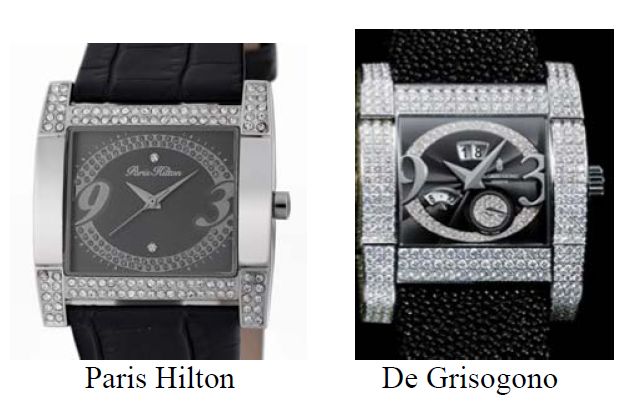
watch-design-patent-lawsuit-infringement-paris-hilton-sued.jpgSince she blew onto the scene and gained notoriety from her 2004 sex tape, Paris Hilton has become a trademark licensing phenomenon, lending her name to a wide range of products, from shoes to perfumes. Her latest watch design, however, may not be as successful after being sued for patent infringement. Fine jewelry and watch designer de Grisogono has manufactured and sold the Novantatre watch since 2007. The term “Novantatre” is Italian for “93”, referring to the prominently displayed “9” and “3” on the watch’s face.

To protect the watch’s design, Plaintiff applied for and was granted U.S. Patent Nos. D596,052 (“the ‘052 patent”) and D627,673 (“the ‘673 patent”). The ‘052 patent covers the square-shaped casing design of the watch and the ‘673 patent relates to the ornamental design of the watch dial, including the positioning of the “9” and the “3”. Plaintiff is accusing the Paris Hilton-branded “Coussin” wristwatch of copying the same protected design elements covered by the two patents.

Plaintiff alleges that it sent multiple cease and desist letters to the defendants, which were ignored. Thus, Plaintiff contends that the infringement is willful and intentional and is requesting not only for disgorgement of Defendants’ profits under 35 U.S.C. § 289, but also for the court to triple the award under 35 U.S.C. § 284.

design-patent-watch-paris-hilton-wristwatch.jpgIn addition to suing Paris Hilton Entertainment, Plaintiff is also suing the manufacturer Parlux as the exclusive licensee of the Paris Hilton trademark used on the watch, and Crossbow International and Mr. Pascal Savoy because they have possession and/or control of the Paris Hilton websites where the watches are sold.

The 9th Circuit’s recent Louis Vuitton v. Akanoc Solutions ruling affirmed a web host’s liability for failing to close down websites that were selling counterfeit goods. A jury trial resulted in a $32.4 million award, where the web hosts were jointly liable with the web site operators selling counterfeit goods that infringed Louis Vuitton’s trademarks and copyrights. The trial court then reduced the damages award by approximately $10 million. The 9th Circuit agreed that the web host was jointly liable, but further reduced the damages award because the verdict form improperly allowed multiple awards of statutory damages for willful copyright and trademark infringement against each infringer. “[W]hen statutory damages are assessed against one defendant or a group of defendants held to be jointly and severally liable, each work infringed may form the basis of only one award, regardless of the number of separate infringements of that work.” Columbia Pictures Television v. Krypton Broad. of Birmingham, Inc., 106 F.3d 284, 294 (9th Cir. 1997), rev’d on other grounds, Feltner v. Columbia Pictures Television, Inc., 523 U.S. 340 (1998)). Thus, the 9th Circuit vacated the damages award and ordered an award of approximately $10.8 million jointly and severally against all of the defendants.

The case is De Grisogono, S.A., v. Paris Hilton Entertainment, et al., CV11-9022 SVW (C.D. Cal. 2011).

September 13, 2011

Skechers Sues Steven Madden For Patent and Trade Dress Infringement Over Twinkle Toes Shoes

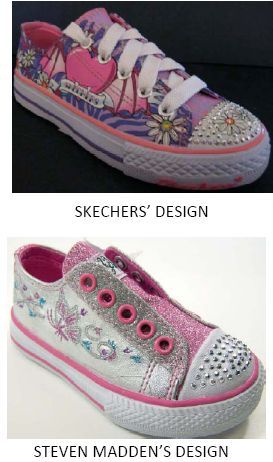
design-patent-shoes-trade-dress-steven-madden-skechers.jpgSkechers is suing Steven Madden for allegedly copying Skechers’ Twinkle Toes shoe designs. The U.S. Patent & Trademark Office granted U.S. Patent No. D571,095 to Skechers covering its Twinkle Toes toe cap design for shoes. In addition to patent protection, Skechers claims that it is the owner of an inherently distinctive trade dress in its Twinkle Toes footwear designs. Skechers defines its trade dress as the combination of the following design elements: “a vulcanized canvass sneaker; a toe cap adorned with crystals, rhinestones, sequins or a plurality of other similar shiny elements; and, canvass uppers distinguished by colorful art designs or patterns.” For trade dress to be protectable, it must be non-functional. And Skechers asserts that the Twinkle Toes design is non-functional and simply conveys a distinctive appearance that is a source indicator.
Skechers further alleges that it has expended many millions of dollars promoting and advertising its trade dress and, based on extensive, frequent, and ongoing advertising, marketing, sales and distribution, the trade dress has acquired distinctiveness, which indicates that the shoes emanate from a single source. In other words, consumers recognize and associate the shoe design with Skechers.

Steve Madden’s “Stevies” brand shoes are accused of including “a vulcanized canvas sneaker, a toe cap adorned with crystal, rhinestones, sequins or a plurality of other similar shiny elements, and canvas uppers distinguished by colorful art designs or patterns” that infringe the subject patent. Further, Skechers contends that the Stevies footwear line so closely resembles the Twinkle toes trade dress that it is likely to cause confusion, mistake, and deception as to an affiliation, connection, or association of Steve Maddens’ footwear with Skechers. Skechers also contends that “Defendants have acted willfully, in bad faith and with the intent to confuse and mislead the public and unfairly trade on the substantial and valuable goodwill associated with Skechers' Twinkle Toes® Trade Dress and to capitalize on Skechers' highly respected reputation as a stylish, high quality footwear company.”

Design patents provide the owner with several competitive advantages. For example, design patents, during their fourteen year lifespan, can be used to legally prevent competing products from entering the market while the owner also establishes trade dress rights by attaining secondary meaning. Trade dress rights can then be used to perpetually protect the product configuration for as long as the trade dress is being used as a source identifier. Also, unlike utility patents, 35 USC § 289 allows a disgorgement of the defendants’ profits from any infringing sales. Design patents provide fashion designers protection for their clothing and shoe designs, which are considered useful articles that are not protectable by copyrights. Indeed, Steve Madden was recently sued by Jeffrey Campbell for design patent and trade dress infringement for allegedly copying the Lita shoe.

Additionally, a patented design may be infringed regardless of distinguishing trademarks or labels applied to the product that can defeat a trade dress claim. In L.A. Gear, Inc. v. Thom McAn Shoe Co., 988 F.2d 1117 (Fed. Cir. 1993), the Federal Circuit affirmed the finding of design patent infringement but reversed the trade dress infringement claim because defendants’ conspicuous labels and trademarks applied to the shoes made confusion among consumers unlikely. Although the Lanham Act also provides for disgorgement of the infringer’s profits, a double recovery is not allowed for infringement of the same design patent and trade dress. See, e.g., Contour Chair Lounge Co. v. True-Fit Chair, Inc., 648 F. Supp. 704, 719, 1 U.S.P.Q.2D (BNA) 1353, 1364 (E.D. Mo. 1986) ("Plaintiff is also entitled to lost profits for [trade dress infringement]; however, plaintiff has already recovered these damages under its patent claim.").

The case is Skechers U.S.A., Inc. v. Steven Madden, Ltd. et al., CV11-07295 PA (C.D. Cal. 2011).

July 20, 2011

Sonya Ooten Files Jewelry Patent & Copyright Infringement Lawsuit Against Soixante Neuf

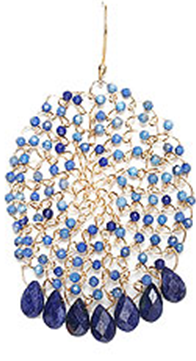
jewelry-patent-copyright-infringement-sonya-ooten.pngJewelry designer Sonya Frisina does business as Sonya Ooten and has a retail store in Los Angeles. Ooten owns U.S. Design Patent No. D544,389, titled “Metal Crochet Earring,” covering the ornamental jewelry design. There is often overlap with different forms of intellectual property and Ootent, to maximize protection, also registered the “Cosmos” earring design with the U.S. Copyright Office.

Ooten alleges that Soixante Neuf’s “Oval Woven Beaded Earrings” infringe both its design patent and copyright. To prove design patent infringement, Ooten must meet both the ordinary observer test and points of novelty test. The design as a whole is examined in the ordinary observer test and the individual elements of the design are examined in the points of novelty test. To prove copyright infringement, unlike design patent infringement, Ooten must show that Soixante Neuf had access to Ooten’s design and copied it. Also, unlike utility patents, a successful design patent plaintiff can recover the infringer’s profits, plaintiff’s lost profits, or a combination of lost profits and reasonable royalty.

The case is Sonya Frisina v. Soixane Neuf, Inc. et al., CV11-5705 VBF (C.D. Cal. 2011).

June 28, 2011

Enovsys Sues AT&T Mobility For Infringing Cell Phone Location Patents

patent-infringement-att-telenav-enovsys.jpgEnovsys filed a patent infringement lawsuit in Los Angeles against AT&T Mobility for infringing two patents: (1) US Patent No. 6,560,461, titled “Authorized Location Reporting Paging System” (“the ‘461 patent”), and (2) US Patent No. 7,925,273, titled “Method and Apparatus for Updating the Location of a Mobile Device Within a Wireless Communication Network” (“the ‘273 patent”). The ‘273 patent is a continuation of the application that resulted in the ‘461 patent, which means the ‘273 patent has the same invention disclosure as the ‘461 patent but with different claimed subject matter or scope.

The ‘461 patent’s invention uses satellites and ground control stations to determine a subscriber’s cell phone location and allows the subscriber to select which users can obtain the subscriber’s whereabouts. The patent also covers relaying the names and locations of nearby stores, restaurants, etc. based on the location of the cell phone. The ‘273 patent relates to a method of controlling the time intervals between updates to the cell phone’s location. The complaint accuses several AT&T applications of infringing the patents, including AT&T FamilyMap, AT&T Navigator, TeleNav Track, and Xora GPS TimeTrack.

Enovsys also alleges that Sprint-Nextel is currently licensing the subject patents in addition to others. The earlier Enovsys v. Nextel-Sprint lawsuit resulted in a jury award of $2.78 million in damages and eliminated the lack of standing defense. In the Nextel case, the Federal Circuit – aside from rejecting Nextel’s invalidity and non-infringement arguments – affirmed the jury’s verdict that the inventor’s ex-wife did not have a community property interest in the patents and did not need to be a named plaintiff.

The case is Enovsys LLC v. AT&T Mobility LLC et al., CV11-05210 DDP (C.D. Cal. 2011).

June 12, 2011

Jeffrey Campbell Sues Steve Madden For Copying Lita Shoe Design

Los Angeles, CA – Jeffrey Campbell is taking an aggressive approach to protecting its shoe designs by recently suing Forever 21 for allegedly copying six of its shoe designs. Last week, Jeffrey Campbell filed a new design patent and trade dress infringement and unfair competition lawsuit against Steve Madden for allegedly copying Jeffrey Campbell’s “Lita” shoe design. Although Jeffrey Campbell did not have any patents for the six shoe designs in the Forever 21 lawsuit, it was granted Patent No. D634,532 for the Lita shoe design. Having a design patent provides greater protection for fashion designs than trade dress alone and the causes of action can always be combined, as Jeffrey Campbell has done here. Campbell claims that Steve Madden’s $169.95 Carnby-L shoe design “is believed to be a copy or knockoff of Jeffry Campbell’s Lita Shoe design.” Steve Madden is no stranger to trademark lawsuits involving shoes, having previously settled with Asics for allegedly copying its stripe design.

design-patent-jeffrey-campbell-lyta-shoe-steve-madden.jpg

The patent provides another advantage by keeping copycats away while the product’s configuration attains secondary meaning in the consumers’ minds. Plaintiff contends that since “the release of the Lita Shoe by Jeffrey Campbell in or about the summer of 2010, the internet has been ablaze with, and blogs have raved about,” the shoe design. The significant publicity and promotion of the Lita shoe design has allegedly led to significant sales and acclaim, and widespread public recognition of the Lita Shoe Trade Dress, which is defined as:

Continue reading "Jeffrey Campbell Sues Steve Madden For Copying Lita Shoe Design" »

April 17, 2011

Genentech Files Cabilly III Patent Infringement Lawsuit Over Benlysta And Arzerra Sales

patent-infringement-biotech-glaxo-genentech-Cabilly.jpgLos Angeles, CA – Genentech and City of Hope are the owners of U.S. Patent No. 7,923,221 (“the Cabilly III patent”), entitled “Methods of Making Antibody Heavy and Light Chains Having Specificity for a Desired Antigen,” issued on April 12, 2011. Plaintiffs wasted no time suing GlaxoSmithKline, Human Genome Sciences, and Lonza Biologics for patent infringement, which suit was filed on the patent’s issue date. The ‘221 patent claims priority to the Cabilly II patent, filed in 1988, which in turn claims priority to the Cabilly I patent, filed in 1983. The Cabilly III patent is the most recent arsenal introduced into years of patent lawsuits, appeals, and USPTO re-examination proceedings. Details here. The Cabilly II patent was the subject of the landmark U.S. Supreme Court decision in MedImmune v. Genentech, 549 U.S. 118 (2007), which eliminated the "reasonable apprehension of suit" test for establishing declaratory judgment jurisdiction.

The Cabilly patents relate to methods for producing antibodies using recombinant DNA. Plaintiffs allege that HGS and GSK have entered into a co-development and commercialization agreement for the development and sale of Benlysta®. Plaintiffs further allege that Lonza Biologics manufactures ofatumumab in the United Kingdom and supplies it to GSK, with knowledge that GSK incorporates ofatumumab into the final Arzerra™ product.

The case is Genentech, Inc. et al. v. Glaxo Group Limited, et al., CV11-03065 SVW (C.D. Cal. 2011).

January 31, 2011

eForCity Sues Apple For Design Patent, Trademark, And Copyright Declaratory Judgment of Non-Infringement

design-patent-trademark-copyright-apple-headset-eforcity-infringement.jpgLos Angeles, CA – eForCity Corporation has sued Apple, Inc. seeking the Court’s declaration that its sales of various earphones do not infringe Apple’s Patent Nos. D589,491, D469,753, D596,616, and D515,070. The lawsuit was filed after Apple’s attorneys sent a cease and desist letter accusing eForcity of also infringing Apple’s copyrights by using iPad images allegedly copied from Apple’s website. Further, the letter accused eForCity of infringing Apple’s iPad, iPhone, iPod and Mac trademarks in product descriptions with the ® or ™ symbols and without attribution to Apple. The case is eForCity Corp, et al. v. Apple, Inc., CV11-00808 SVW (C.D. Cal. 2011).

January 4, 2011

Appeals Court Finds Microsoft Infringed Uniloc’s Patent And Grants New Damages Trial

uniloc-cafc-federal-circuit-win-damages-patent-microsoft-infringe.pngWashington, D.C. – The Court of Appeals for the Federal Circuit (“CAFC”) overturned the district court’s finding of non-infringement. After Uniloc won a jury award of $388 million, the district court granted judgment as a matter of law (“JMOL”) of non-infringement and no willfulness on Microsoft’s post-trial motions. Details blogged here.

In reversing the district court’s decision, the CAFC found that “[b]ecause the jury’s verdict on infringement was supported by substantial evidence, this court reverses the district court’s grant of JMOL of non-infringement; this court also reverses the district court’s alternative grant of a new trial on infringement as an abuse of discretion.” The CAFC, however, affirmed the district court’s finding of no willful infringement because “the jury’s verdict on willfulness was not supported by substantial evidence.” The CAFC further affirmed the district court’s denial of Microsoft’s motion for JMOL of invalidity.

As to damages, the CAFC granted a new trial because “the jury’s damages award was fundamentally tainted by the use of a legally inadequate methodology.” In doing so, the CAFC disbanded the 25% rule of thumb (25%/75% royalty split between licensor/licensee) as a basis for royalties that it had previously “tolerated”: “This court now holds as a matter of Federal Circuit law that the 25 percent rule of thumb is a fundamentally flawed tool for determining a baseline royalty rate in a hypothetical negotiation. Evidence relying on the 25 percent rule of thumb is thus inadmissible under Daubert and the Federal Rules of Evidence, because it fails to tie a reasonable royalty base to the facts of the case at issue.”

The CAFC opinion is available here.

The CAFC concluded: “For the foregoing reasons, this court reverses the district court’s grant of JMOL of non-infringement, affirms the district court’s grant of JMOL of no willfulness, affirms the district court’s grant of a new trial on damages, vacates the district court’s grant of an alternative motion for new trial on infringement, and affirms the district court’s denial of JMOL of invalidity of claim 19 of the ’216. The case is remanded for proceedings consistent with this opinion.”

August 12, 2010

Burton Snowboards Sued For Patent Infringement

patent-attorney-snowboard-bindings-burton-patent-infringement.jpgSanta Ana, CA – Peter Van Bregmann is suing Burton Snowboards for infringing on a snowboard binding patent. Plaintiff alleges that in 1996 he met with Burton and after signing a confidentiality agreement, Plaintiff showed his invention to Burton, but it was not interested. On March 2, 1999, Plaintiff was issued U.S. Patent No. 5,876,045, entitled “Angularly Adjustable Snowboard Boot Binding,” which generally relates to a lever system that allows for convenient adjustment of boot bindings, whereby the use of tools is eliminated.

Defendant is accused of willfully infringing the patent by manufacturing a snowboard boot binding marketed under the “Burton Progression Custom Rental Binding” mark. The case is Bregmann v. Burton Snowboards North America, SACV-10-1199 DOC (C.D. Cal. 2010).